In three sentences
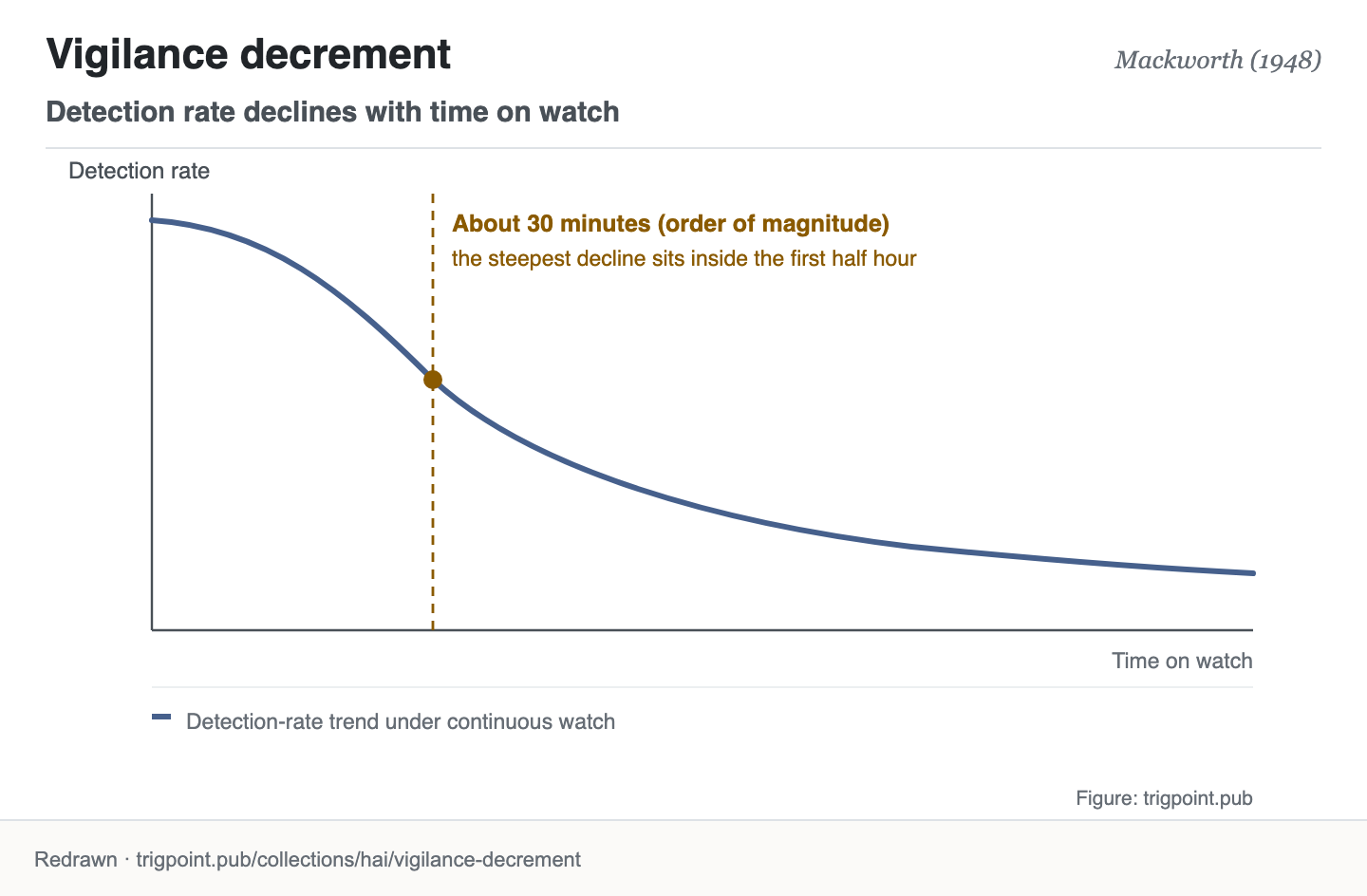
Vigilance decrement is the decline in detection rate over time on watch when a person keeps monitoring a signal source that rarely changes.Misses reflect a limit of human attention, not a discipline problem, so the fix belongs in how the monitoring is designed, not in trying harder.When the only safeguard is having someone watch the automation, the risk of a miss grows with time on watch; in Mackworth's experiment detection had dropped measurably within about thirty minutes (an order of magnitude, reported secondhand).
Figure 1 · Decay of detection rate during sustained monitoring. As reported secondhand, in Mackworth's radar-clock experiment detection rate falls sharply within roughly the first thirty minutes and then continues to decline slowly. The trend is redrawn; the primary data were not checked, so the shape is shown without a numeric scale. View full size ▸Share PNG ▸
During the Second World War, airborne radar operators of the British RAF Coastal Command were missing submarine signals in the back half of a watch. Mackworth reproduced the effect with a clock face whose hand jumped in steps: the subject watched the pointer and reported the occasional double jump.
Attribution where due: "Vigilance" as a neurological concept appears earlier, in Henry Head (1923). What Mackworth contributed in 1948 is the first systematic experiment and the quantified curve. Predecessors are predecessors; the experiment is the experiment.
2. Why this matters to you
Handing an AI agent's output to "someone will keep an eye on it" bets the reliability of the system on a curve that slides the longer the watch runs. Your attention depletes. So a human-oversight design that amounts to asking someone to watch is not a safety mechanism. It is safety theatre.
The question is not who watches. It is how the monitoring surface should be built so that it still catches things once the human has slackened: rotation, sampling, and pushing anomalies to the person rather than waiting for the person to find them.
Boundary: "about thirty minutes" is an order of magnitude and not a constant, reaches us through secondary reporting, and must be calibrated against your own data before it goes into a shift specification; this page does not supply the numeric shape of the curve.
The opening text and the check are in the member edition
When it applies is open to everyone. The text to paste when you start, how to check what comes back, and the known misreadings for this node are in the member edition.
Verification details and failure boundaries are for members.
False alarm P0: fixing the detector before false warnings blunt the monitoring surface
Situation: at the time, each day our starting and closing briefings checked how up to date each AI role's decision record was. From 26 June 2026, two briefings in a row reported one role as having a backlog of 13 days and put it on the priority list. The root cause was one line that assumed an order: some records put the newest entry first, yet the detection always took the last date in the file as the latest, and so picked up the oldest entry.
Decision point: once the root cause was known, there were four workable options. One, ask whoever reads the briefing to check the dates by hand. Two, loosen the rule so warnings appear less often. Three, pause the check. Four, rewrite the detection so the result does not depend on the order of the records.
What we did and what happened: we took the fourth option. The warning was not skipped; it stayed on the priority list until the cause was found. But a monitoring surface that keeps raising false alarms teaches people to skip warnings, real ones included; we did not wait for that. A check made when the root cause was found showed the role was 0 days behind. The fix was completed on 28 June: the detection now compares all the dates and takes the latest, and that day's closing briefing reported the role 0 days behind. Negative result: until the cause was found, a backlog that did not exist held a place on the priority list, and the briefing advised that role to catch up on its decision record as soon as it started work.
Take-away: if a false alarm comes from how a figure is computed, change the computation itself rather than relying on readers to check each figure by hand; until it is fixed, it keeps its place on the priority list and can send people off to do work that is not needed. A person with only one AI assistant and a dated notes file can, when asking it for the most recent entry, have it compare all the dates before it answers.
02
Trigpoint PassField record · doctrine clause level
Redesigning the monitoring surface: turning the direction of vigilance decrement into rules
Rules measured in one studio (n=1): which surfaces may keep a standing monitor, which must switch to push notification, and how the spot-check frequency is set. We took the direction of the decline, not the thirty minute figure.
Trigpoint Pass content · includes an applicable clause template
How to read the source notes “Bibliographic details checked” means author, year, title and venue were confirmed. It does not mean the source's claims were checked. Definitions as of 2026-09-20.
[1] Mackworth, N. H. (1948). The breakdown of vigilance during prolonged visual search. Quarterly Journal of Experimental Psychology, 1(1), 6–21. https://doi.org/10.1080/17470214808416738↩
Tell the editor privately: a correction, a counter-example or where it applies
Submissions are read only by the editor, and your original text and nickname are never published. If a note stands and this node is revised, the revision is listed in this page's correction record; notes that are not adopted currently get no published summary or response. An anonymous note cannot be tracked by its reference number; submit signed in to follow its status on your page. No sign-up is needed, and the nickname may be left blank.
SaveSavedSavedContinue readingReadAllocation ledgersClear saved items and reading history on this deviceThese are kept only in this browser on this device.You can sign in with your email (free) to keep your saved items and ledgers in your account and pick them up on another device.Keep the saved items and ledgers on this device in your account?Keep in my accountNot nowSaved on this device. You can sign in to keep it in your account.Keep saved items and ledgers in my accountIf you turn this off, the saved items and ledgers in your account are deleted. The copy on this device stays.