Members' shelf
All 9 nodes on Naming & Classification are for members only.
Pay with the email you sign in with here, so the Pass is linked to this account.
Members' shelf
All 16 nodes on System Protection & Threat Modeling are for members only.
Pay with the email you sign in with here, so the Pass is linked to this account.
Situation awareness
1. What happened
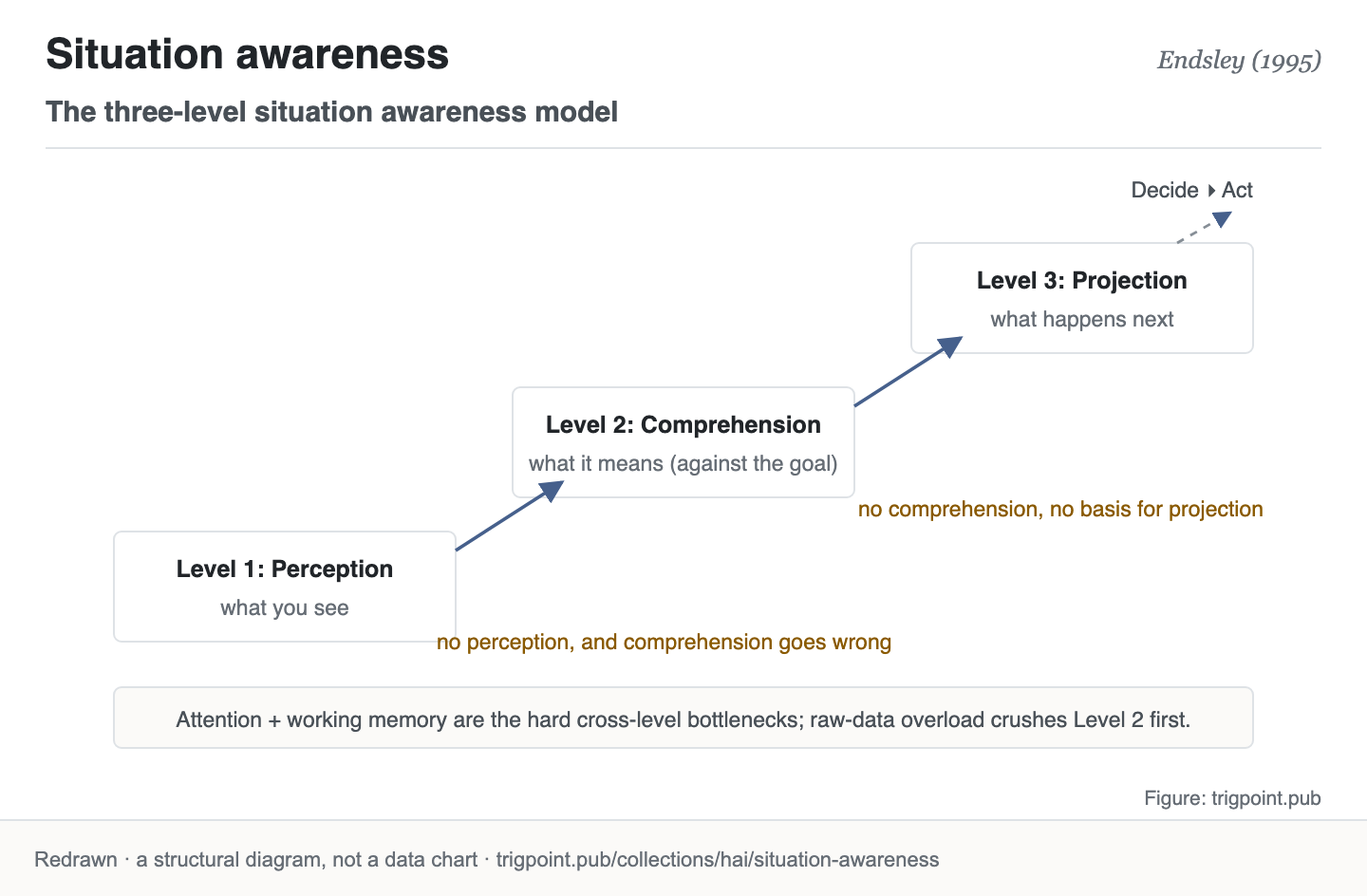
Knowing the situation is not the same as knowing what to do. Endsley took "knowing what is going on", which had been scattered through aviation human factors research, and formalised it into a workable three-level model. The definition of the three levels is usually traced to her 1988 work (by her own later account), and her 1995 paper extended it into a full theory covering attention, working memory, mental models and goal-driven processing[1]Endsley, M. R. (1995). Toward a Theory of Situation Awareness in Dynamic Systems. Human Factors, 37(1), 32–64. Bibliographic details cross-checked against multiple sources.. Level one, perception: detecting the state of the relevant elements in the environment. Level two, comprehension: integrating those elements into meaning relative to a goal. Level three, projection: predicting the near future on the basis of that understanding. The levels ascend, and higher means more complete awareness, but they are not strictly linear stages: a gap in perception makes errors in comprehension likely, yet goal-driven processing and mental models can still produce levels two and three when level one is incomplete. The whole structure is bounded by attention and working memory, most visibly for novices, while experts relieve the limit with mental models and pattern matching. That is why pouring in more raw information tends to crush level two rather than help it.
2. Why this matters to you
When you are running several AI workstreams in parallel, the bottleneck is rarely a shortage of information. It is almost always that the picture will not assemble. A dashboard supplies the raw material for level one, but comprehension and projection have to be designed in: state shown against the goal, staleness marked explicitly, next step readable directly. Dumping every agent output in front of yourself uses the volume of level one to smother level two.
Boundary: awareness is the input to a decision, so it cannot be inferred from whether the decision turned out right; the three levels ascend, so a level-one detection rate does not establish awareness.
Take it to your AI Trial
When it applies
Several AI assistants each run a line of work; you read their reports, but the picture will not assemble and the next step is hard to decide.
Paste when you start · Research term · Check what comes back · Common misreadingIn the member edition ▸Read the member edition ▸
The opening text and the check are in the member edition
When it applies is open to everyone. The text to paste when you start, how to check what comes back, and the known misreadings for this node are in the member edition.
Verification details and failure boundaries are for members.
US$8.25 a month on average · or subscribe monthly ▸
Pay with the email you sign in with here, so the Pass is linked to this account.
Lab cases 2 first-hand cases from our studio
First look at start-up: why a situation board over-reported work in progress
Situation: in a studio running several lines of work at once, every start-up has to answer one question first: what is the situation now. On 16 June 2026 we turned the answer into a situation board generated by a script. Each working role gets one row with four cells: the most important open task, the work in progress, the open item that has waited longest, and the most overdue handoff. The whole board is capped at fifty lines, and every cell is derived from the source records.
Decision point: on 20 June a comparison with another board showed that about 13 entries in the in-progress cell were not actually in progress, and some had sat for eight or nine days: the rule counted every record not yet closed as in progress. There were at least four workable options. One, close the old records by hand. Two, add a reminder at the end of each session. Three, count a record as in progress only if it was opened within the last day and is still open. Four, remove the cell.
What we did and what happened: we took the third option. After the board was regenerated, the in-progress cell dropped to zero, which matched what was actually happening. The negative result: changing the rule cleared the board, but most of the old records were still not closed; these records are listed every day in a separate section instead, and a person still decides, record by record, whether to continue each one or close it.
Take-away: if the in-progress status on a board is derived from records that are still open, and no one can be counted on to close those records, the rule can add a time condition; otherwise items opened long ago keep showing as in progress. Someone who uses only one AI assistant and a to-do list can do one thing this week: next to each item in progress, note the date it was started, and at start-up move anything started more than a day ago and still not done to a separate column, then decide item by item whether to continue it or close it.
After an interruption: the mechanism for rebuilding situation awareness across sessions
What to record at the end of a session and what to scan at the start of the next, so that the previous comprehension can be picked up again. We wrote this into a fixed mechanism rather than relying on memory.
Trigpoint Pass content · includes a continuation checklist
Full access to the lab cases. Trigpoint Pass ▸
How to read the source notes “Bibliographic details checked” means author, year, title and venue were confirmed. It does not mean the source's claims were checked. Definitions as of 2026-09-20.
- [1] Endsley, M. R. (1995). Toward a Theory of Situation Awareness in Dynamic Systems. Human Factors: The Journal of the Human Factors and Ergonomics Society, 37(1), 32–64. https://doi.org/10.1518/001872095779049543 ↩
Tell me when a new shelf opens
Tell me when a new shelf opens
Shelf notices are sent only when a new shelf opens or when the reading rules change.
Tell the editor privately: a correction, a counter-example or where it applies
Submissions are read only by the editor, and your original text and nickname are never published. If a note stands and this node is revised, the revision is listed in this page's correction record; notes that are not adopted currently get no published summary or response. An anonymous note cannot be tracked by its reference number; submit signed in to follow its status on your page. No sign-up is needed, and the nickname may be left blank.
We have your note