Members' shelf
All 9 nodes on Naming & Classification are for members only.
Pay with the email you sign in with here, so the Pass is linked to this account.
Members' shelf
All 16 nodes on System Protection & Threat Modeling are for members only.
Pay with the email you sign in with here, so the Pass is linked to this account.
Use, misuse, disuse, abuse
1. What happened
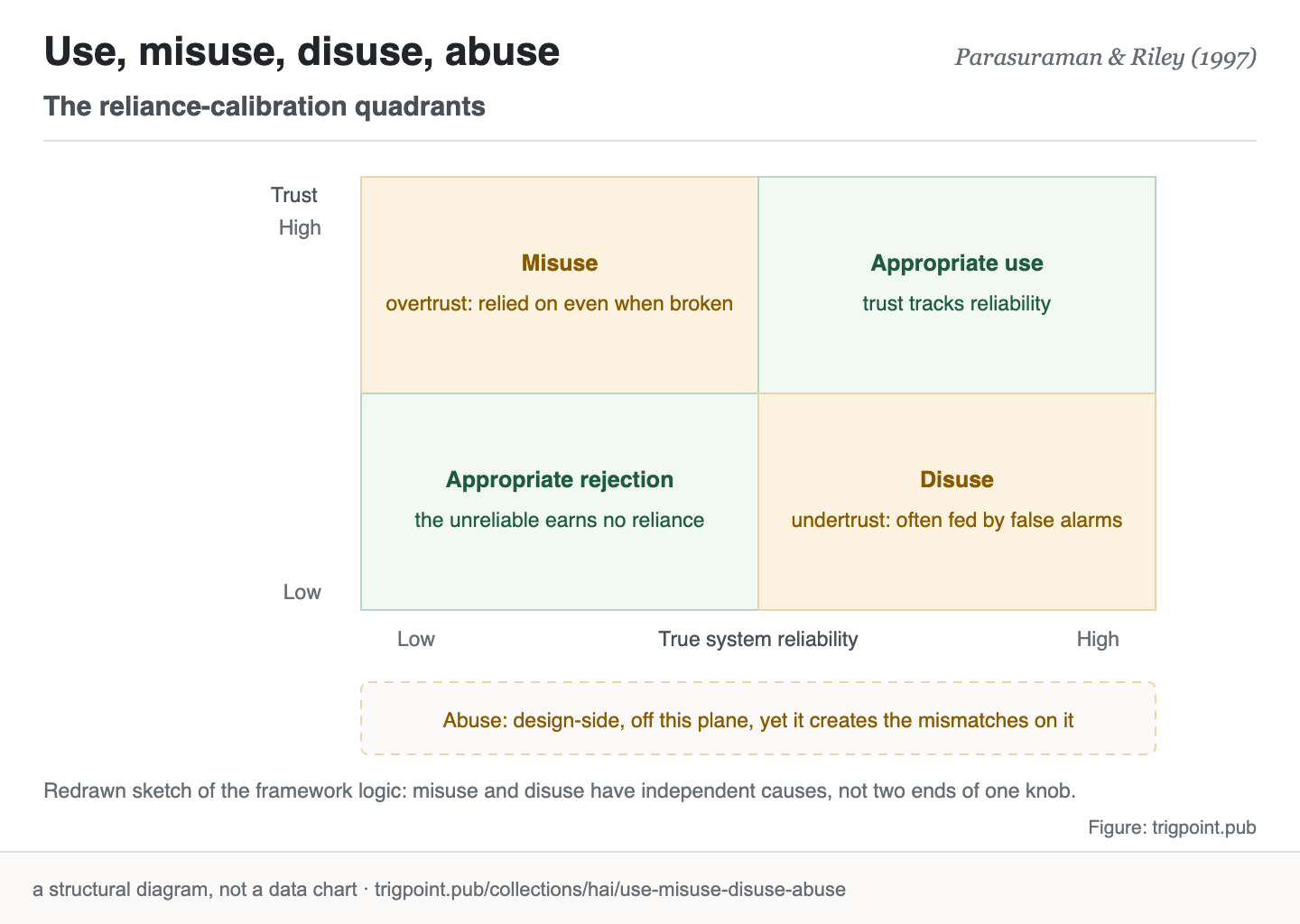
Some people lean on automation too hard and others will not use it at all; the two are often treated as two directions of one problem. In 1997 Parasuraman and Riley rewrote "automation failure" from an argument about whether humans or machines are more reliable into a question of whether reliance is appropriate, and set out the four terms[1]Parasuraman, R., & Riley, V. (1997). Humans and Automation: Use, Misuse, Disuse, Abuse. Human Factors, 39(2), 230–253. Bibliographic details checked against the official record. The summary of the definitions of the four terms follows secondary accounts that agree with one another.. Misuse comes from trust above actual reliability: monitoring slackens and output is followed uncritically. Disuse comes from trust below actual reliability, most often driven by an alarm with too high a false alarm rate, which in turn usually traces back to a design that never worked out the base rate of the event being detected.
Abuse turns the camera back on the design and management side: pushing automation through without regard for its human consequences is the upstream source of the first two. The least intuitive point: driving the false alarm rate down to cure disuse can push misuse up. The two problems have independent causes and do not share a dial.
2. Why this matters to you
When an automated alert in a workflow starts getting skipped, the first instinct is to blame the person. The quadrant reading runs the other way. Check the alarm's false alarm rate and the base rate first, which is a design question. Then check whether reliance is calibrated to actual reliability, which is a relationship question. The person's discipline comes last. And there is a question that usually gets skipped entirely: should this have been automated at all? Ask the four separately and the fixes stop fighting each other.
Boundary: the four terms are a taxonomy of mismatch, not a maturity scale; misuse and disuse have independent causes and can coexist.
Take it to your AI Trial
When it applies
An alert, review or check has been handed to AI and people's job is to look at its output, but the output is starting to be skipped or accepted without checking.
Paste when you start · Check what comes back · Common misreadingIn the member edition ▸Read the member edition ▸
The opening text and the check are in the member edition
When it applies is open to everyone. The text to paste when you start, how to check what comes back, and the known misreadings for this node are in the member edition.
Verification details and failure boundaries are for members.
US$8.25 a month on average · or subscribe monthly ▸
Pay with the email you sign in with here, so the Pass is linked to this account.
Lab cases One first-hand case from our studio
False alarm P0, second lesson: before you suppress false alarms, work out whether you are raising blind trust
One false alarm incident walked through the four quadrants again: false alarms would feed disuse, and once the correction goes too far it turns round and feeds misuse. The two problems do not share one dial.
Trigpoint Pass content · same incident as the open preview case on Vigilance decrement
Full access to the lab cases. Trigpoint Pass ▸
How to read the source notes “Bibliographic details checked” means author, year, title and venue were confirmed. It does not mean the source's claims were checked. “Follows secondary accounts” means the claim rests on sources that report it, not on the original document. Definitions as of 2026-09-20.
- [1] Parasuraman, R., & Riley, V. (1997). Humans and Automation: Use, Misuse, Disuse, Abuse. Human Factors: The Journal of the Human Factors and Ergonomics Society, 39(2), 230–253. https://doi.org/10.1518/001872097778543886 ↩
Tell me when a new shelf opens
Tell me when a new shelf opens
Shelf notices are sent only when a new shelf opens or when the reading rules change.
Tell the editor privately: a correction, a counter-example or where it applies
Submissions are read only by the editor, and your original text and nickname are never published. If a note stands and this node is revised, the revision is listed in this page's correction record; notes that are not adopted currently get no published summary or response. An anonymous note cannot be tracked by its reference number; submit signed in to follow its status on your page. No sign-up is needed, and the nickname may be left blank.
We have your note