Members' shelf
All 9 nodes on Naming & Classification are for members only.
Pay with the email you sign in with here, so the Pass is linked to this account.
Members' shelf
All 16 nodes on System Protection & Threat Modeling are for members only.
Pay with the email you sign in with here, so the Pass is linked to this account.
Levels of automation
- Holds when
- When deciding how far to hand a task to a machine, and an error costs differently at each stage.
- Evidence
- Conceptual framework; Bibliography checked
- Breaks down when
- Setting one level for a whole system, or assuming higher is better: once people leave execution, recovery after failure suffers.
1. What happened
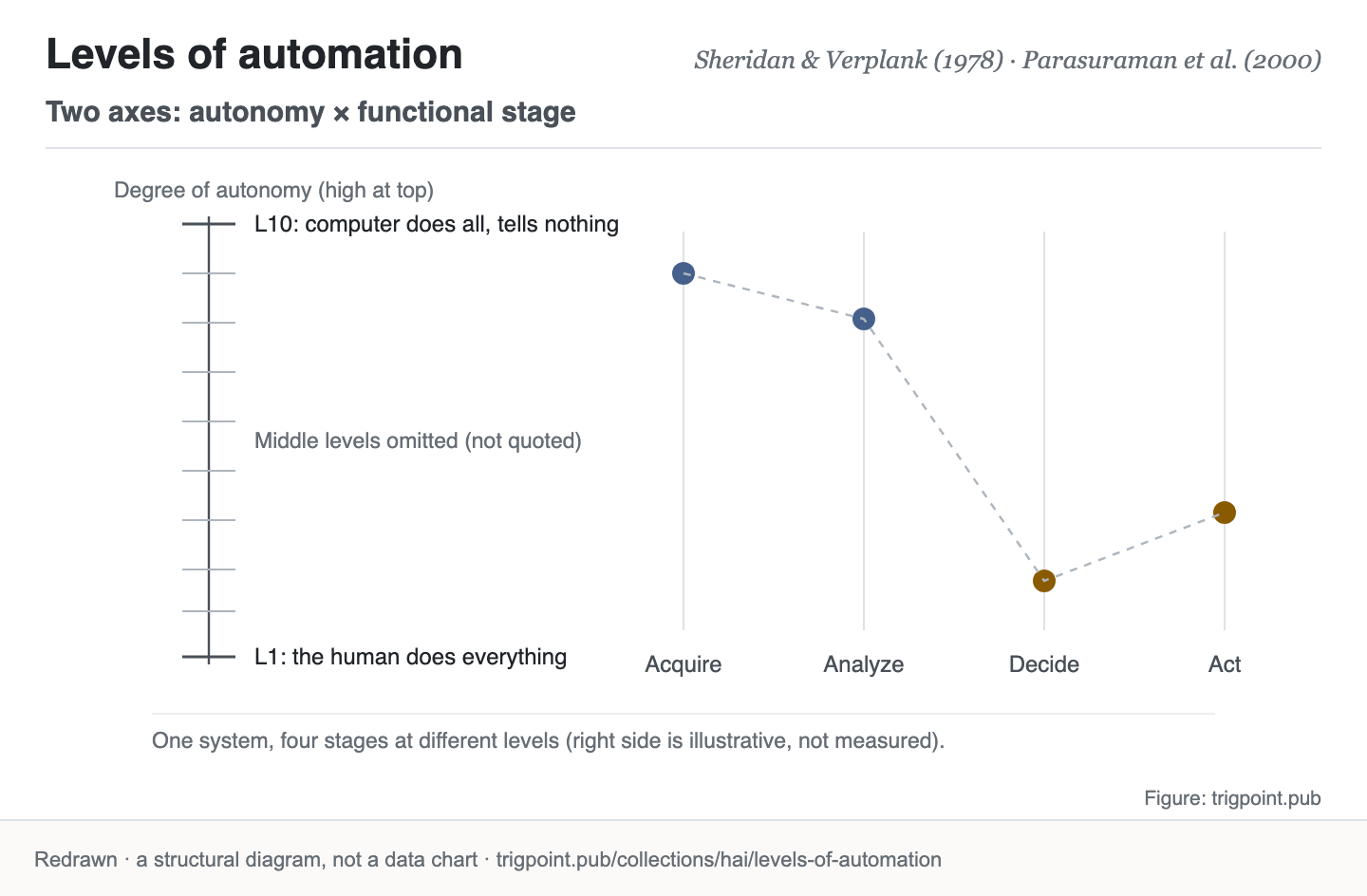
Treating automation as a switch misses one thing: different stages of the same system can sit at different levels. In 1978 Sheridan and Verplank proposed a ten-point scale of autonomy in a research report on undersea teleoperation, running from level one, where the human does everything, to level ten, where the computer acts and does not inform the human[1]Sheridan, T. B., & Verplank, W. L. (1978). Human and Computer Control of Undersea Teleoperators. MIT Man-Machine Systems Laboratory. Bibliographic details checked against the official record. Provenance double-checked across models. This page does not quote the original wording level by level..
In 2000 Parasuraman, Sheridan and Wickens added a second axis: automation acts on four classes of information processing (acquisition, analysis, decision, action), and each class can be set independently[2]Parasuraman, R., Sheridan, T. B., & Wickens, C. D. (2000). A Model for Types and Levels of Human Interaction with Automation. IEEE Transactions on Systems, Man, and Cybernetics, Part A, 30(3), 286–297. Bibliographic details checked against the official record. Provenance double-checked across models..
There is evidence on the cost side too. Endsley and Kaber (1999) had 30 participants work a dynamic control task at different levels of automation. Performance gains came mainly from automating the implementation stage, and only under normal operation. Once the human was removed from implementation, recovery after an automation failure suffered. When human and computer generated options together, performance fell below either one alone. Automating the decision stage, meaning the choice among options, brought lower workload and higher situation awareness, with only a slight gain in performance[3]Endsley, M. R., & Kaber, D. B. (1999). Level of automation effects on performance, situation awareness and workload in a dynamic control task. Ergonomics, 42(3), 462–492. Bibliographic details checked against the official record. Provenance double-checked across models. The sentences reporting experimental results follow the paper's abstract.. So "how automated should this be" is a stage-by-stage trade-off, not a case of higher being better.
2. Why this matters to you
The most useful move when granting authority to an AI agent is to split the work into the four stages and ask about each one. Can gathering be fully automated? Can analysis? What about the decision? What about execution? For most situations the answers differ: gathering and analysis can sit high on the scale, while decisions and irreversible actions stay low. A blanket "trust the AI" or "do not trust the AI" gives you nothing to act on inside this framework.
Boundary: moving up the scale is a trade. In the same experiment, implementation-stage automation raised performance under normal operation but left recovery from failure worse, and joint option generation lowered performance. The ten-point scale was written for 1978 undersea teleoperation, so confirm your setting is comparable before reusing it.
Take it to your AI Trial
When it applies
When deciding how far to hand a task to a machine, and an error costs differently at each stage.
Paste when you start
The task is [your task]. Before you start, split it into four stages (gathering information, analysis, decision, execution) and write, for each stage, how far you will go on your own and where you will hand it back to me. For any decision between options, or any action that cannot be undone once taken, list the options and your reasons first and wait for my confirmation before acting. For each stage you will carry out on your own, note the step from which I should take over if something goes wrong.
Check what comes back
For each of the four stages, does the reply say how far the AI went on its own and where it handed the work back? Did decisions and actions that cannot be undone stop and wait for your confirmation?
Counter-examples and failure boundaries
Both misuses come from flattening the two axes into one. The first is treating level of automation as one setting for a whole system, which throws away the stage-by-stage resolution that is the entire contribution of the framework. The second is merging autonomy level and processing stage into a single axis, which puts you back in switch-style binary thinking after a longer route.
Two further boundaries. In that experiment, implementation-stage automation improved performance under normal operation, but removing the human from implementation left recovery after a failure worse, and joint option generation lowered performance[3]Endsley, M. R., & Kaber, D. B. (1999). Level of automation effects on performance, situation awareness and workload in a dynamic control task. Ergonomics, 42(3), 462–492. Bibliographic details checked against the official record. Provenance double-checked across models. The sentences reporting experimental results follow the paper's abstract.. Moving up the scale is therefore a trade to be weighed, not a free upgrade. And the ten-point scale itself was written in 1978 for undersea teleoperation, with its individual level wordings never checked against the primary source. Before treating it as a general-purpose set of settings, confirm that your situation is comparable to remote manipulation.
Lab cases 2 first-hand cases from our studio
Suggest, do not execute: a recurring review split into three stages, with the ruling left to a person
Situation: the studio's starting briefing and closing briefing are recurring reviews. They were set to run once a day, gathering the state of each line of work and collecting rulings from the person running the studio. In the month from 16 August 2026, the number of work records per day ranged from 2 to 92, yet each briefing cost the same every day.
Decision point: when the briefings were redesigned on 16 September, there were at least four workable options. One, hand both briefings whole to a scheduler and run them automatically. Two, when a briefing is detected as due, open a working session automatically to run it. Three, split it by stage: computation goes to the scheduler, the due reminder goes to the dashboard, and rulings stay in a briefing that a person starts. Four, keep the daily arrangement, run by hand.
What we did and what happened: we took the third option, and the person running the studio agreed the same day. The first two were rejected: a fully scheduled run gives more accurate detection with nobody to answer it, and when to start is a person's call, while the dashboard is a static page that cannot collect answers. The scheduler only runs read-only computations; the dashboard shows only why a briefing is due and cannot start one: suggest, do not execute. In the computation results kept up to 10 October, the starting and closing reminders were due in 88% and 78% of them respectively, so the reminder was in effect back to a daily rhythm. The actual runs did not follow it; they kept to the pace of the person running the studio. On 10 October the person running the studio ruled that a reminder would show only once the number of working days since the last run reached a limit, a change to settings alone. No sustained quiet period occurred in that time, so whether that limit alone is enough could not be tested.
Take-away: if part of a recurring review is to be handed to automation, first split the review into three stages: computation, reminder and ruling. The first two can be handed over, with a trial period after which someone compares how often the reminder showed as due with how often the review actually ran; the ruling stays with a person.
The four-stage allocation table: which stages may be fully automated and which may not
Situation: this studio is run by one person, and daily operation depends on several dozen automated surfaces. Some scan topic sources every morning; some propose archiving at the end of a working day. Every new one raises the same question: how far can it be let go?
Decision point: there were at least four workable options. One, argue each case. Two, give each surface a single on-off switch. Three, set the whole surface at one middle level. Four, split it into four stages (acquisition, analysis, decision and execution), set a level for each stage, and write down the reason.
What we did and what happened: arguing case by case cost too much, so we took the fourth option and wrote it up as a standing allocation table. The levels follow two criteria of the studio's own: can an error at this stage be undone, and does it travel on to the next stage. Acquisition is fully automated, analysis sits high, decision is locked at “suggest, do not execute”, and execution stays at the lowest level with a procedural lock. One basis for the decision row comes from a correction. The monthly review used to sit on an unattended schedule, and a review that needs a person to supply judgment, set up that way, degrades into a formality nobody reviews. On 9 June 2026 we made it manually triggered, and the schedule now only carries the reminder. A reminder can be automated. A review cannot.
Take-away: if the stages of a piece of work differ in what an error costs, the work can be split into the four stages and each stage set separately. A stage where an error can be undone and does not travel on may go high; a stage that carries responsibility or cannot be undone stays locked at “suggest, do not execute” or lower. Minimum viable version: a person with only one AI assistant and a to-do list can, this week, take one task handed to the assistant and write one line on the list for each of the four stages, noting who decides at that stage and why.
Records how far each claim was checked, not a guarantee that it is true.
How it was checked
All three bibliographic anchors hold. Parasuraman, Sheridan and Wickens 2000 (IEEE Trans SMC-A 30(3):286–297)[2]Parasuraman, R., Sheridan, T. B., & Wickens, C. D. (2000). A Model for Types and Levels of Human Interaction with Automation. IEEE Transactions on Systems, Man, and Cybernetics, Part A, 30(3), 286–297. Bibliographic details checked against the official record. Provenance double-checked across models. and Endsley and Kaber 1999 (Ergonomics 42(3):462–492)[3]Endsley, M. R., & Kaber, D. B. (1999). Level of automation effects on performance, situation awareness and workload in a dynamic control task. Ergonomics, 42(3), 462–492. Bibliographic details checked against the official record. Provenance double-checked across models. The sentences reporting experimental results follow the paper's abstract. match field for field. The experimental results attributed to Endsley and Kaber come from the paper's abstract; the full text was not checked. The ten-point scale does originate in the 1978 Sheridan and Verplank report from MIT rather than in the 1980 or 1992 sources it is sometimes cited to, and that dating converges across the DTIC record, the WorldCat entry, and the secondary citation record[1]Sheridan, T. B., & Verplank, W. L. (1978). Human and Computer Control of Undersea Teleoperators. MIT Man-Machine Systems Laboratory. Bibliographic details checked against the official record. Provenance double-checked across models. This page does not quote the original wording level by level..
One further check concerns where the four stages came from. That skeleton was not invented in 2000; the paper says it builds on the existing human information processing tradition, and a deeper pass also corrected a bibliographic mispairing from the first check, where the publisher and the ISBN prefix for Wickens 1984 had been matched to the wrong house.
One item stays unverified: the table number and pagination inside the 1978 report were not checked against the primary source, so this page places the scale in Chapter 8 on the strength of secondary citations and does not commit to a table number[1]Sheridan, T. B., & Verplank, W. L. (1978). Human and Computer Control of Undersea Teleoperators. MIT Man-Machine Systems Laboratory. Bibliographic details checked against the official record. Provenance double-checked across models. This page does not quote the original wording level by level..
How to read the source notes “Bibliographic details checked” means author, year, title and venue were confirmed. It does not mean the source's claims were checked. Definitions as of 2026-09-20.
- [1] Sheridan, T. B., & Verplank, W. L. (1978). Human and Computer Control of Undersea Teleoperators. Cambridge, MA: MIT Man-Machine Systems Laboratory. https://doi.org/10.21236/ADA057655 ↩
- [2] Parasuraman, R., Sheridan, T. B., & Wickens, C. D. (2000). A Model for Types and Levels of Human Interaction with Automation. IEEE Transactions on Systems, Man, and Cybernetics, Part A, 30(3), 286–297. https://doi.org/10.1109/3468.844354 ↩
- [3] Endsley, M. R., & Kaber, D. B. (1999). Level of automation effects on performance, situation awareness and workload in a dynamic control task. Ergonomics, 42(3), 462–492. https://doi.org/10.1080/001401399185595 ↩
Tell me when a new shelf opens
Tell me when a new shelf opens
Shelf notices are sent only when a new shelf opens or when the reading rules change.
Tell the editor privately: a correction, a counter-example or where it applies
Submissions are read only by the editor, and your original text and nickname are never published. If a note stands and this node is revised, the revision is listed in this page's correction record; notes that are not adopted currently get no published summary or response. An anonymous note cannot be tracked by its reference number; submit signed in to follow its status on your page. No sign-up is needed, and the nickname may be left blank.
We have your note