Members' shelf
All 9 nodes on Naming & Classification are for members only.
Pay with the email you sign in with here, so the Pass is linked to this account.
Members' shelf
All 16 nodes on System Protection & Threat Modeling are for members only.
Pay with the email you sign in with here, so the Pass is linked to this account.
Mental workload (NASA-TLX)
1. What happened
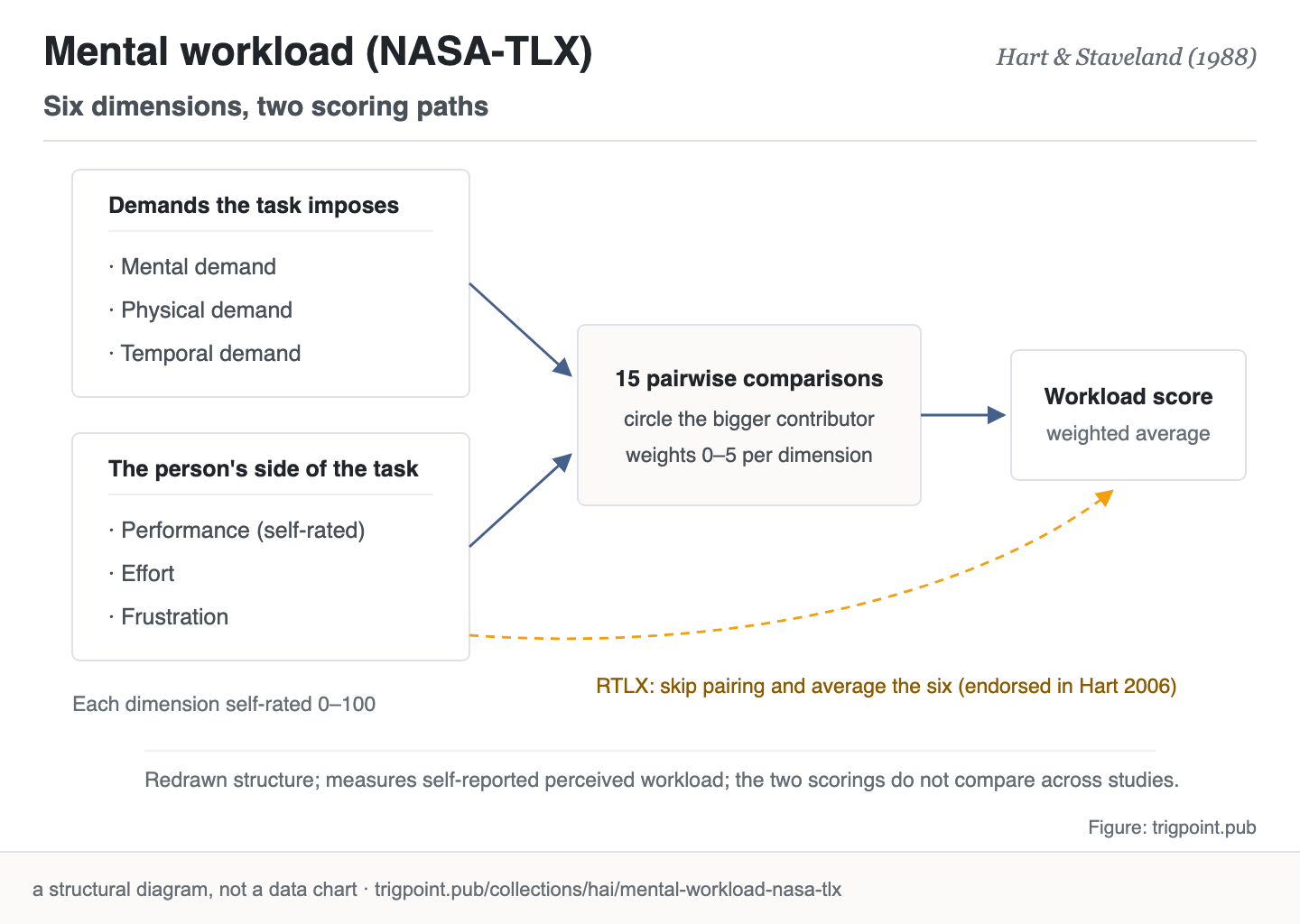
To measure something no one can see, you have to ask the person living through it. In 1988 Hart and Staveland at NASA Ames gathered three years of research, more than forty experiments according to the official NASA manual, into a single scale[1]Hart, S. G., & Staveland, L. E. (1988). Development of NASA-TLX (Task Load Index): Results of Empirical and Theoretical Research. In Hancock & Meshkati (Eds.), Human Mental Workload (pp. 139–183). North-Holland. Bibliographic details cross-checked against multiple sources. Checked against the official manual.. The starting point was that a single overall score is too coarse: it hides where the load comes from, and it varies widely between people.
Their answer was to rate six dimensions from 0 to 100 each, then have the respondent set the weights through fifteen pairwise comparisons, choosing in each pair which dimension contributed more to the load for that particular task. Take the weighted mean and you have a workload score. Twenty years later Hart reviewed five hundred and fifty studies that had used or reviewed it. The most common modification was to drop the pairing and simply average the six, the Raw TLX; among the comparison studies he reviewed, the sensitivity results were mixed, and his view was that you can take your pick[2]Hart, S. G. (2006). NASA-Task Load Index (NASA-TLX); 20 Years Later. Proceedings of the Human Factors and Ergonomics Society Annual Meeting, 50(9), 904–908. Bibliographic details cross-checked against multiple sources..
2. Why this matters to you
Managing your own load or a team's starts with the structural lesson in TLX: workload is multidimensional and a single total will mislead you. Time pressure at the ceiling and frustration at the ceiling are entirely different problems, and folding them into one "tired" score leaves you nothing to treat. The second lesson is about honesty. Any self-reported workload is a subjective measurement and can come apart from objective output, so you need to watch both. Reporting a score without stating how it was computed, weighted or plain average, is a gap in the method.
Boundary: the score is a retrospective self-report, not an objective load measurement, and it says nothing about situation awareness; the weighted and plain-average versions are not directly comparable across studies.
Take it to your AI Trial
When it applies
After you hand part of the work to AI and switch to checking its output, you want to see which kinds of load the remaining work puts on you.
Paste when you start · Research term · Check what comes back · Common misreadingIn the member edition ▸Read the member edition ▸
The opening text and the check are in the member edition
When it applies is open to everyone. The text to paste when you start, how to check what comes back, and the known misreadings for this node are in the member edition.
Verification details and failure boundaries are for members.
US$8.25 a month on average · or subscribe monthly ▸
Pay with the email you sign in with here, so the Pass is linked to this account.
Open question · AI-drafted Trial
Time pressure at the ceiling and frustration at the ceiling are entirely different problems, and folding them into one "tired" score leaves you nothing to treat.
The last time work left you tired, if you take it apart, which was it mostly: time pressure, mental demand, or frustration? Once you took it apart, did you handle it differently?
Tell the editor privately ▸Why is this here?
This node has no reader responses yet, so we put one question here as a starting point. It is not the editor's view of the node. It is folded away once readers respond, or at the first monthly update after it has been up for 30 days.
Lab cases One first-hand case from our studio
How to measure load in a one-person studio: four axes, red, amber, green
At intervals, the operator self-reports red, amber or green on four axes, with one or two sentences of raw event alongside, and no total score. Multidimensional, subjective, self-reported: that position matches the original intent of the instrument. The dimensions are not merged, a total score would mislead, and self-report does not pretend to be objective. The full case carries how the four axes were chosen and who is responsible for interpreting the report once it is made.
Full access to the lab cases. Trigpoint Pass ▸
How to read the source notes “Bibliographic details checked” means author, year, title and venue were confirmed. It does not mean the source's claims were checked. “Matched against the full text” means the claim was compared with the text of the source itself. Definitions as of 2026-09-20.
- [1] Hart, S. G., & Staveland, L. E. (1988). Development of NASA-TLX (Task Load Index): Results of Empirical and Theoretical Research. In P. A. Hancock & N. Meshkati (Eds.), Human Mental Workload (pp. 139–183). Amsterdam: North-Holland. https://doi.org/10.1016/S0166-4115(08)62386-9 ↩
- [2] Hart, S. G. (2006). NASA-Task Load Index (NASA-TLX); 20 Years Later. Proceedings of the Human Factors and Ergonomics Society Annual Meeting, 50(9), 904–908. https://doi.org/10.1177/154193120605000909 ↩
Tell me when a new shelf opens
Tell me when a new shelf opens
Shelf notices are sent only when a new shelf opens or when the reading rules change.
Tell the editor privately: a correction, a counter-example or where it applies
Submissions are read only by the editor, and your original text and nickname are never published. If a note stands and this node is revised, the revision is listed in this page's correction record; notes that are not adopted currently get no published summary or response. An anonymous note cannot be tracked by its reference number; submit signed in to follow its status on your page. No sign-up is needed, and the nickname may be left blank.
We have your note