Members' shelf
All 9 nodes on Naming & Classification are for members only.
Pay with the email you sign in with here, so the Pass is linked to this account.
Members' shelf
All 16 nodes on System Protection & Threat Modeling are for members only.
Pay with the email you sign in with here, so the Pass is linked to this account.
Automation complacency and bias
1. What happened
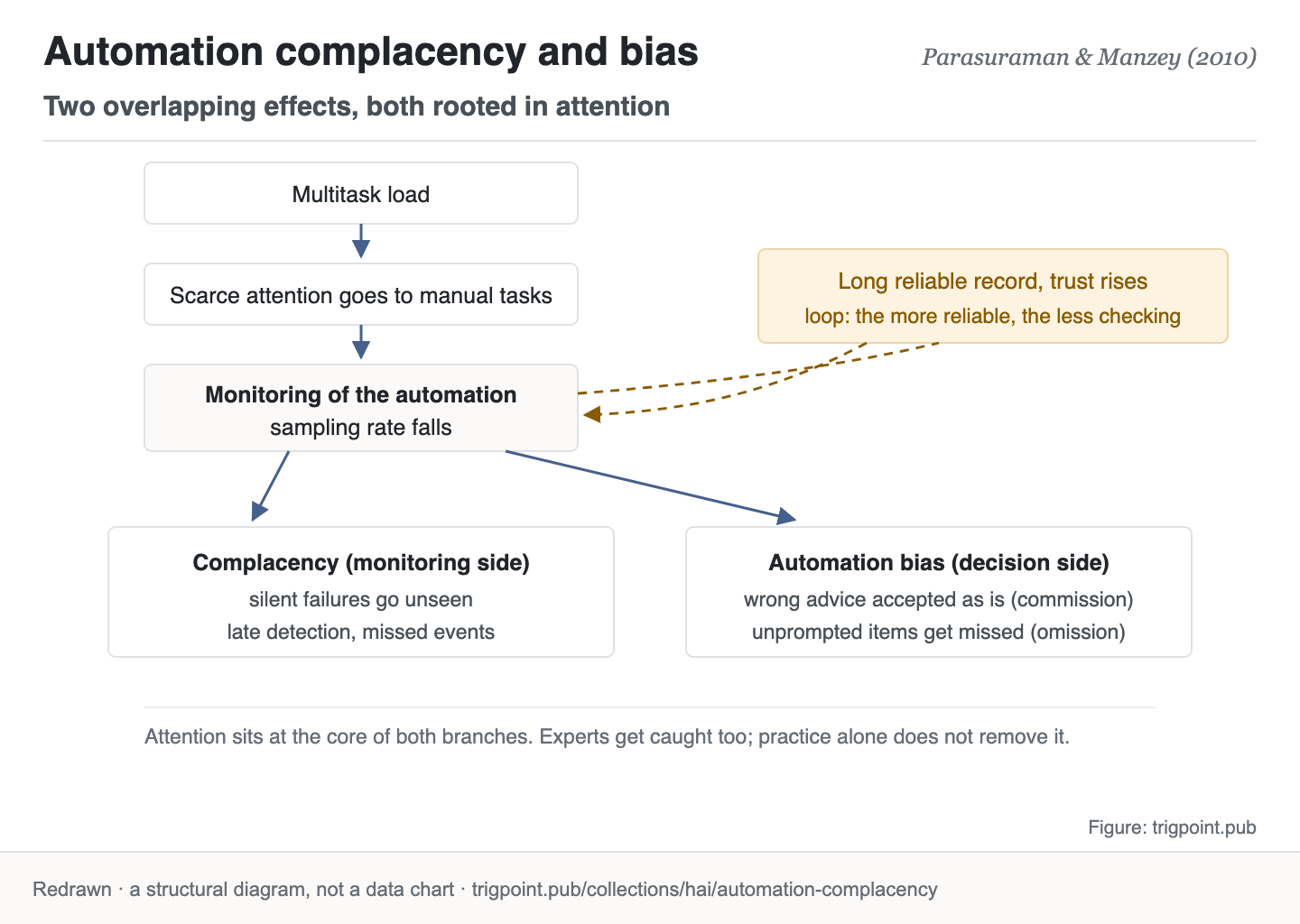
One failure sits on the monitoring side and the other on the decision side, so they look unrelated. In 2010 Parasuraman and Manzey reviewed years of empirical work and integrated two phenomena that had been discussed separately into a single model[1]Parasuraman, R., & Manzey, D. H. (2010). Complacency and Bias in Human Use of Automation: An Attentional Integration. Human Factors, 52(3), 381–410. Bibliographic details checked against the official record. Consistent with the abstract. Provenance double-checked across models.. The model does not cover every form of bias, only the part tied to inattention and selective attention; for that part, the authors hold that the two involve essentially the same attentional processes.
The chain runs like this. Multitask load makes attention scarce, people allocate it to the task that needs their hands, and the sampling rate for monitoring the automation drops.
The complacency branch: silent failures go unseen and detection is delayed. The bias branch: the system's prompt becomes a heuristic that replaces the person's own information search, so wrong recommendations are accepted (commission) and missing ones are overlooked (omission).
The more reliable the system, the higher the trust and the harder the sampling rate falls, which closes a self-reinforcing loop. The paper infers a second loop running the other way: having experienced an automation failure, trust and complacency potential fall back. Novices and experts are both affected, and extended practice does not eliminate the effect; the paper suggests that variable-priority training, and first-hand experience of automation failure, may reduce it.
2. Why this matters to you
The more consistently good the automation's output, the less often you check it, and that curve holds for you as well. The paper lists four directions for mitigation: making operators accountable for the outcome, allocating functions between person and machine flexibly, giving people practical experience with the specific automated system, and support that analyses information rather than recommending a decision (the evidence for the last is preliminary). Trying to beat an attentional structure by reminding yourself to stay alert is a fight with poor odds.
Boundary: bias refers specifically to commission and omission errors under imperfect decision aids and is not general over-trust; the mechanism here is checked mainly against the abstract, with four points checked against the full text, so a design that needs exact parameters cannot rest on this page.
Take it to your AI Trial
When it applies
An AI already does your routine prep, its output has been steady, and you approve its drafts and recommendations while busy with other work.
Paste when you start · Research term · Check what comes back · Common misreadingIn the member edition ▸Read the member edition ▸
The opening text and the check are in the member edition
When it applies is open to everyone. The text to paste when you start, how to check what comes back, and the known misreadings for this node are in the member edition.
Verification details and failure boundaries are for members.
US$8.25 a month on average · or subscribe monthly ▸
Pay with the email you sign in with here, so the Pass is linked to this account.
Lab cases 2 first-hand cases from our studio
Automated prep works well, right up until nobody checks it any more
Situation: at the time, an external agent handled AI prep for us, regularly scanning competitor pricing and industry events and preparing background material for the weekly choice of topics. The usage rule had only one half written: we did not rescan by hand what it had already prepared, and we only ranked, chose topics and made the rulings.
Decision point: when we reviewed the rule on 10 July 2026, the question was where a person checks. There were at least four workable options. One, use the prepared material as it is. Two, go back to rescanning by hand. Three, keep relying on it for retrieval, and have a person check against the source before any figure or event background enters a judgement. Four, spot-check some of it from time to time.
What we did and what happened: we took the third option and that day completed the rule in two halves. Rely on it for retrieval; verify before adoption, with everything it delivered treated from the start as a first-pass draft. The rule cited the study on this page as its basis: the more reliable the automation, the faster people's rate of checking it falls. Rereading the paper on 7 October 2026 showed that the mitigations it lists do not include a verification step: the study supports the phenomenon, not this countermeasure. We repointed the basis to our own classification of incidents, and the rule's wording stayed the same.
Take-away: if a rule for using AI cites research as its basis, one option is to go back to the original and establish whether the research supports the phenomenon or the countermeasure; where it supports only the phenomenon, the countermeasure needs a basis of its own. Minimum viable version: someone who uses only one AI assistant and a notes file can, this week, pick one practice in their notes that cites research as its reason, open that research, and see whether this practice is among the countermeasures the research itself lists.
Why this step is still done by hand: the collected clauses against blind trust
For every position that could be automated but is deliberately kept manual, we wrote down the reason. Collected together, they are the whole set of clauses against complacency.
Trigpoint Pass content · clause-level reference
Full access to the lab cases. Trigpoint Pass ▸
Records how far each claim was checked, not a guarantee that it is true.
Corrections- 2026-10-07 · The page said that complacency and bias are one attentional mechanism. A cross-model review against the paper found that, taken as a whole, the two are overlapping and similar phenomena; the integration model covers only the part of bias tied to inattention and selective attention, and the claim of essentially the same attentional processes holds only for that part. The wording was changed to overlapping phenomena with attention at their core, and the model's coverage was added to the text.
- 2026-10-07 · The page listed a mandatory verification step, a sampling mechanism and a varying check rhythm as effective interventions. None of these is among the mitigations the paper lists, which are accountability, flexible function allocation, practical experience with the automated system, and support that analyses information rather than recommending a decision. The sentence now gives the paper's four.
How to read the source notes “Bibliographic details checked” means author, year, title and venue were confirmed. It does not mean the source's claims were checked. “Consistent with the abstract” means the claim agrees with the paper's abstract. It does not include sentence-by-sentence checking against the full text. Definitions as of 2026-09-20.
- [1] Parasuraman, R., & Manzey, D. H. (2010). Complacency and Bias in Human Use of Automation: An Attentional Integration. Human Factors: The Journal of the Human Factors and Ergonomics Society, 52(3), 381–410. https://doi.org/10.1177/0018720810376055 ↩
Tell me when a new shelf opens
Tell me when a new shelf opens
Shelf notices are sent only when a new shelf opens or when the reading rules change.
Tell the editor privately: a correction, a counter-example or where it applies
Submissions are read only by the editor, and your original text and nickname are never published. If a note stands and this node is revised, the revision is listed in this page's correction record; notes that are not adopted currently get no published summary or response. An anonymous note cannot be tracked by its reference number; submit signed in to follow its status on your page. No sign-up is needed, and the nickname may be left blank.
We have your note