Members' shelf
All 9 nodes on Naming & Classification are for members only.
Pay with the email you sign in with here, so the Pass is linked to this account.
Members' shelf
All 16 nodes on System Protection & Threat Modeling are for members only.
Pay with the email you sign in with here, so the Pass is linked to this account.
Trust in automation
1. What happened
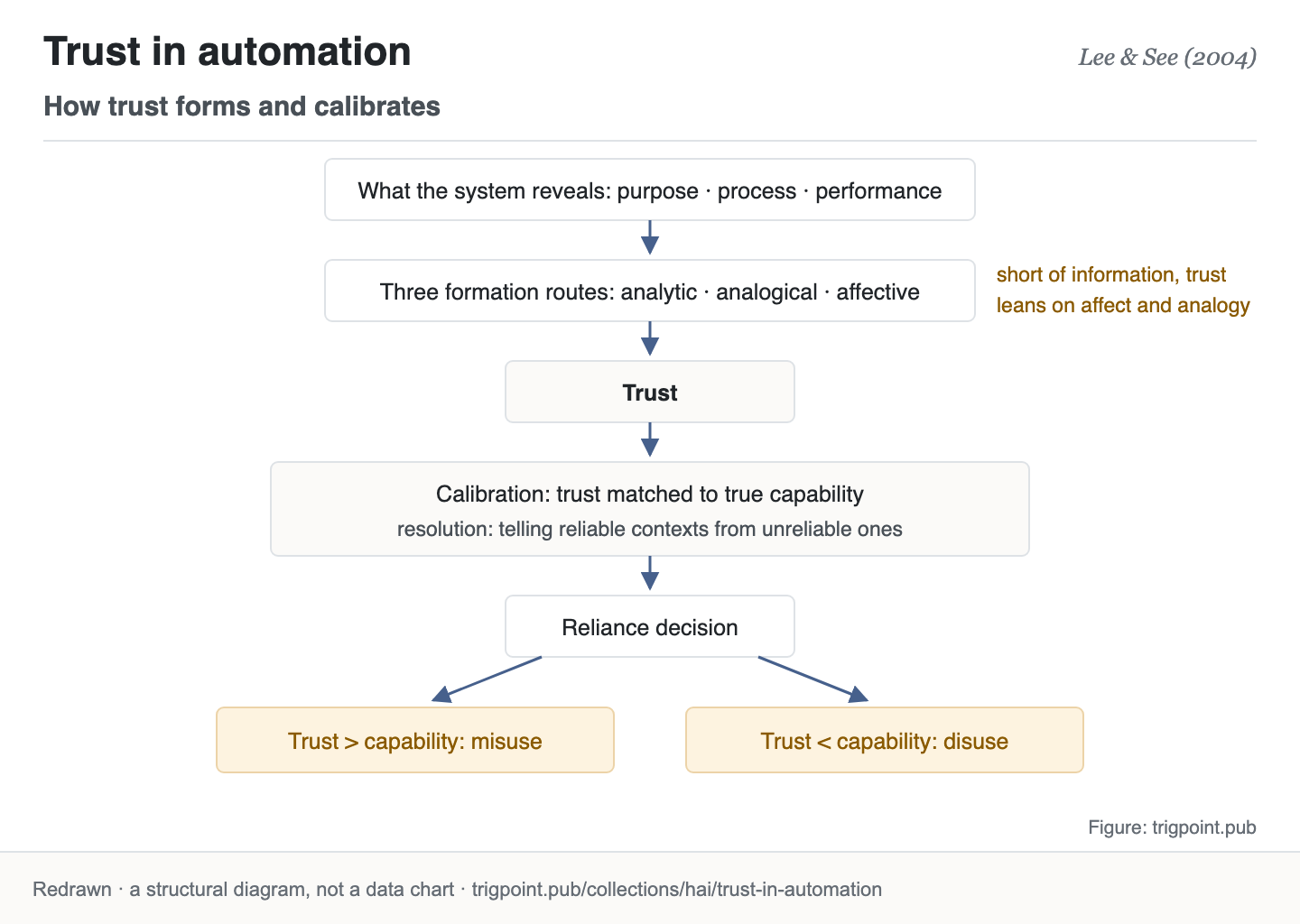
When designing a human-machine system, it feels natural to want users to trust it a little more. In 2004 Lee and See pulled scattered work on trust together into the unifying framework for the field[1]Lee, J. D., & See, K. A. (2004). Trust in Automation: Designing for Appropriate Reliance. Human Factors, 46(1), 50–80. Bibliographic details cross-checked against multiple sources. The summary of the framework's core claims follows secondary accounts that agree with one another.. Two of its central concepts for judging whether trust is appropriate are calibration, where the level of trust matches actual capability, and resolution, where trust can distinguish the situations in which the system is reliable from those in which it is not. Trust is fed by three kinds of information about the system, its purpose, its process, and its performance, and it forms through three psychological routes, analytic, analogical, and affective. What the interface exposes determines where trust goes. This page infers that when the information is unavailable, people are more likely to fall back on the affective and analogical shortcuts, and the risk of miscalibration rises with it.
2. Why this matters to you
"How do we make users trust the AI more" points in the wrong direction. The accidents caused by too much trust and the capacity wasted by too little are equally real. The question you can act on is this: in which situations is this system reliable, in which is it not, and can the user tell the difference? If they cannot, expose the process and the performance in the interface. Trust is something you calibrate. Trust you have talked up is just credulity.
Boundary: the goal is calibration and not elevation, and calibration has to resolve where the system is reliable and where it is not; trust is a dynamic state, not a trait; the framework here is confirmed at secondary-source grade only.
Take it to your AI Trial
When it applies
You hand drafting or sorting to an AI assistant and are left deciding which parts to use as given and which to check.
Paste when you start · Research term · Check what comes back · Common misreadingIn the member edition ▸Read the member edition ▸
The opening text and the check are in the member edition
When it applies is open to everyone. The text to paste when you start, how to check what comes back, and the known misreadings for this node are in the member edition.
Verification details and failure boundaries are for members.
US$8.25 a month on average · or subscribe monthly ▸
Pay with the email you sign in with here, so the Pass is linked to this account.
Lab cases Written only where there is evidence
No field record for this node yet.
How to read the source notes “Bibliographic details checked” means author, year, title and venue were confirmed. It does not mean the source's claims were checked. “Follows secondary accounts” means the claim rests on sources that report it, not on the original document. Definitions as of 2026-09-20.
- [1] Lee, J. D., & See, K. A. (2004). Trust in Automation: Designing for Appropriate Reliance. Human Factors: The Journal of the Human Factors and Ergonomics Society, 46(1), 50–80. https://doi.org/10.1518/hfes.46.1.50_30392 ↩
Tell me when a new shelf opens
Tell me when a new shelf opens
Shelf notices are sent only when a new shelf opens or when the reading rules change.
Tell the editor privately: a correction, a counter-example or where it applies
Submissions are read only by the editor, and your original text and nickname are never published. If a note stands and this node is revised, the revision is listed in this page's correction record; notes that are not adopted currently get no published summary or response. An anonymous note cannot be tracked by its reference number; submit signed in to follow its status on your page. No sign-up is needed, and the nickname may be left blank.
We have your note