Trigpoint
“Luhmann invented the slip box”: not necessarily.

Zettelkasten

Zettelkasten · Luhmann (1981)
Bibliography checked ✓ Lab case ✓ Personal knowledge management · note-taking Tell the editor privately ▸
In three sentences A Zettelkasten is a networked note system: each card holds one concept and a unique address, cards point to one another by reference, and decades of accumulation form a web of knowledge.Once dense enough it is more than a filing cabinet: in 1981 Luhmann described it as a communication partner that answers new questions with old cards you had forgotten.What carries over is three structural choices, atomic cards, unique addresses and cross-reference without copying; drop any one and the web starts to rot.

↳ Seen a counter-example?

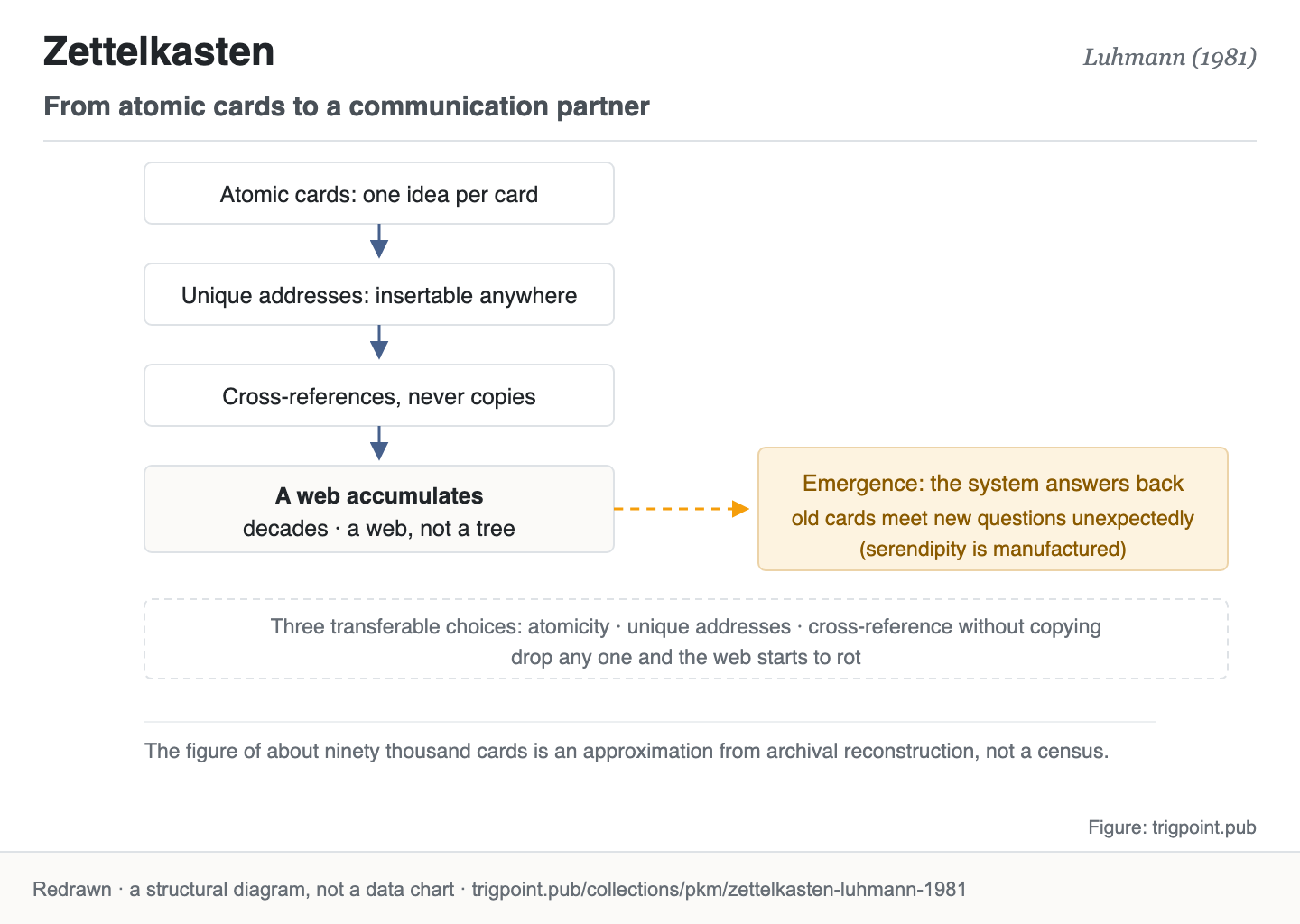
Zettelkasten Luhmann (1981) From atomic cards to a communication partner Atomic cards: one idea per card Unique addresses: insertable anywhere Cross-references, never copies A web accumulates decades · a web, not a tree Emergence: the system answers back old cards meet new questions unexpectedly (serendipity is manufactured) Three transferable choices: atomicity · unique addresses · cross-reference without copying drop any one and the web starts to rot The figure of about ninety thousand cards is an approximation from archival reconstruction, not a census. Figure: trigpoint.pub
Figure 1 · The slip box mechanism: atomic cards, unique addresses, cross-references accumulating into a web, and the emergent layer Luhmann called a communication partner. The figure of roughly ninety thousand cards is an approximation from archival reconstruction, not a census. Redrawn. View full size ▸

1. What happened

From the 1950s onward Luhmann accumulated physical cards. Each held one concept, atomically, with a unique positional address whose numbering alternated between digits and letters so that a new card could always be inserted between any two existing ones. Cross-references to other cards were written on the card by hand, unconstrained by any tree, so any branch could point at any other.

After decades of this the pile stopped being a filing cabinet. In a 1981 experience report he described it as a second memory he could hold a conversation with, where both sides had to be able to surprise each other[1]Luhmann, N. (1981). Kommunikation mit Zettelkästen. Ein Erfahrungsbericht. In Baier, Kepplinger & Reumann (Hrsg.), Öffentliche Meinung und sozialer Wandel. Opladen: Westdeutscher Verlag, 222–228. Bibliographic details cross-checked against multiple sources. Attribution note: this 1981 original is often miscited as the 1992 reprint, Universität als Milieu. The “communication partner” passages were checked word for word against a scan of the 1981 German print (pp. 222, 225 and 226).. The scale of roughly ninety thousand cards comes from a later archival reconstruction[2]Schmidt, J. F. K. (2018). Niklas Luhmann's Card Index: The Fabrication of Serendipity. Sociologica, 12(1), 53–60. DOI 10.6092/issn.1971-8853/8350. Bibliographic details checked against the publisher's record. Claims matched against the full text. This is the source for the count of roughly ninety thousand cards. It is a scholarly reconstruction from the Bielefeld archive. The figure is an approximation, not a census.. That study gave the emergent property an accurate name: serendipity is manufactured. Once the web is dense enough, old cards start meeting new questions in places you did not plan.

Attribution where due: Card indexing has been in use since the early modern period, from the sixteenth century on. Luhmann is its best-known practitioner and theoriser, and his 1981 experience report is where the idea that the system answers its user gets stated clearly. The figure of roughly ninety thousand cards is an approximation from Schmidt's 2018 reconstruction and should not be cited as an exact count[2]Schmidt, J. F. K. (2018). Niklas Luhmann's Card Index: The Fabrication of Serendipity. Sociologica, 12(1), 53–60. DOI 10.6092/issn.1971-8853/8350. Bibliographic details checked against the publisher's record. Claims matched against the full text. This is the source for the count of roughly ninety thousand cards. It is a scholarly reconstruction from the Bielefeld archive. The figure is an approximation, not a census.. The practice popular in the English-speaking world largely comes from Ahrens's 2017 book, which turns it into an operational workflow. Cite the two separately[3]Ahrens, S. (2017). How to Take Smart Notes. Bibliographic details cross-checked against multiple sources. Attribution note: this is the popularising book for the English-speaking world. It systematises the method into an operational process. It is not Luhmann's original practice..

2. Why this matters to you

The portable lesson is not "use cards". It is three structural choices: atomicity, so that a reference has a precise target; a unique address, so that pointing is possible at all; and cross-reference without copying, so that a concept exists in exactly one version.

In digital tools those map onto atomic notes, stable links and embedded references. Drop any one and the web starts to rot: concepts get smeared through long documents where nothing can cite them, or the same fact is copied into several versions that then drift apart.

It also has a design domain. This is a long-term system for accumulation across time, not a tool for digesting a single input. Work out which one you are building before deciding which parts to borrow.

Counter-examples and failure boundaries

Three misuses all mistake the best-known practitioner for the inventor.

First, card indexing has been in use since the early modern period, from the sixteenth century on. Luhmann did not invent the method. He is its best-known practitioner and the person who theorised it[2]Schmidt, J. F. K. (2018). Niklas Luhmann's Card Index: The Fabrication of Serendipity. Sociologica, 12(1), 53–60. DOI 10.6092/issn.1971-8853/8350. Bibliographic details checked against the publisher's record. Claims matched against the full text. This is the source for the count of roughly ninety thousand cards. It is a scholarly reconstruction from the Bielefeld archive. The figure is an approximation, not a census..

Second, roughly ninety thousand is an approximation from archival reconstruction rather than a census, and citing it as an exact statistic hardens an estimate into a fact[2]Schmidt, J. F. K. (2018). Niklas Luhmann's Card Index: The Fabrication of Serendipity. Sociologica, 12(1), 53–60. DOI 10.6092/issn.1971-8853/8350. Bibliographic details checked against the publisher's record. Claims matched against the full text. This is the source for the count of roughly ninety thousand cards. It is a scholarly reconstruction from the Bielefeld archive. The figure is an approximation, not a census..

Third, this is a long-term networked system for accumulation across time, not a tool for digesting a single input. Comparing it against linear real-time capture methods compares two different design goals.

One further boundary sits in the transmission chain: the practice popular in English largely comes from Ahrens's 2017 trade book, which turns it into an operational workflow; how its steps differ from Luhmann's own practice was not checked here. Say which one you mean when you cite "the Zettelkasten method"[3]Ahrens, S. (2017). How to Take Smart Notes. Bibliographic details cross-checked against multiple sources. Attribution note: this is the popularising book for the English-speaking world. It systematises the method into an operational process. It is not Luhmann's original practice..

Lab cases 3 first-hand cases from our studio

01
Open previewField record · 2026-07

One concept, one node: three new nodes requested, two built

Situation: our knowledge base has one rule: one concept, one node; nodes point at each other through links, and the same content is never copied a second time, so that one fact does not grow two versions. On 18 July 2026, to support a piece of outward writing, we asked for three new theory nodes.

Decision point: one of the three concepts already had a node in the knowledge base. There were four workable options at the time: (a) build all three as requested; (b) build all three and copy the content of the existing node into the new one; (c) build only the two that were missing, and point to the existing node for the third; (d) return the request and take it up again once someone had checked the existing nodes.

What we did and what happened: we chose (c). The delivery on 21 July built two of the three requested nodes. The existing node had already passed verification on 13 July; a fresh check confirmed that it met the need, and the delivery pointed to it. The request step did not stop the duplicate: the request still listed this concept as one to build, and the storage location it suggested was exactly where that node sat. The request also stated that the knowledge base side would decide on storage and on whether to extend an existing node, and in the end the check on the knowledge base side stopped the duplicate.

Take-away: when a new need calls for a new note, first check the place where the note would be stored for the same concept; if it is there, add a link rather than copying it a second time. This applies to notes that accumulate over a long time and are cited repeatedly. Minimum viable version: someone who uses only one AI assistant and a set of notes can do one thing this week: before adding the next note, have the AI look for the same concept in the existing notes, and if it finds one, write no new note and link to that old note instead.

02
Trigpoint PassField record · 2026-07

When a node counts as one card: the splitting criteria, and integrity first

A research report recommended building 5 nodes on one topic. Following it would make the library finer grained, but we have a rule: a complete argument may not be broken apart for the sake of tidy classification. Which of the 5 should be built?

Trigpoint Pass content · includes applicable criteria

Read the member edition ▸

03
Trigpoint PassField record · 2026-04

How orphan cards are handled: the monthly settlement of nodes with no citations

Three governance documents say nodes with no citations are cleared every month, yet the main library has never kept a single scan result. A rule written but never run; what triggered the few clean-ups of disconnected nodes that actually happened?

Trigpoint Pass content · clause-level reference

Read the member edition ▸

Full access to the lab cases. Trigpoint Pass ▸

Page verification: Bibliography checked ✓ · Page version v3 · Content last revised 2026-11-22 · Editor review 2026-10-06

Verification record

Records how far each claim was checked, not a guarantee that it is true.

How it was checked

The numbers came from the primary source this time. The 2018 reconstruction was extracted and checked directly: roughly ninety thousand A6 cards in two collections, the first running 1951 to 1962 with about twenty-three thousand cards across one hundred and eight sections, the second running 1963 to 1997 with about sixty-seven thousand. All read from the original[2]Schmidt, J. F. K. (2018). Niklas Luhmann's Card Index: The Fabrication of Serendipity. Sociologica, 12(1), 53–60. DOI 10.6092/issn.1971-8853/8350. Bibliographic details checked against the publisher's record. Claims matched against the full text. This is the source for the count of roughly ninety thousand cards. It is a scholarly reconstruction from the Bielefeld archive. The figure is an approximation, not a census..

The "communication partner" passages were checked word for word against a scan of the 1981 German print[1]Luhmann, N. (1981). Kommunikation mit Zettelkästen. Ein Erfahrungsbericht. In Baier, Kepplinger & Reumann (Hrsg.), Öffentliche Meinung und sozialer Wandel. Opladen: Westdeutscher Verlag, 222–228. Bibliographic details cross-checked against multiple sources. Attribution note: this 1981 original is often miscited as the 1992 reprint, Universität als Milieu. The “communication partner” passages were checked word for word against a scan of the 1981 German print (pp. 222, 225 and 226).. Page 222 lists, as one of the elementary preconditions of communication, that the partners can surprise each other. Page 225 says that long work with the technique produces a kind of second memory, an alter ego one can communicate with continuously. Page 226 adds a qualification: the box needs some years to build up enough critical mass, and until then it works only as a container, giving back what was put into it.

Two findings. Luhmann's 1981 experience report is frequently miscited to its 1992 reprint; this page uses the original venue. And the widely repeated figure of about seventy books is round-number lore. The same reconstruction records a list of more than five hundred titles at his death.

References

How to read the source notes “Bibliographic details checked” means author, year, title and venue were confirmed. It does not mean the source's claims were checked. “Matched against the full text” means the claim was compared with the text of the source itself. Definitions as of 2026-09-20.

  1. [1] Luhmann, N. (1981). Kommunikation mit Zettelkästen. In Öffentliche Meinung und sozialer Wandel. Opladen: Westdeutscher Verlag, 222–228. https://doi.org/10.1007/978-3-322-87749-9_19 ↩
  2. [2] Schmidt, J. F. K. (2018). Niklas Luhmann's Card Index: The Fabrication of Serendipity. Sociologica, 12(1), 53–60. https://doi.org/10.6092/issn.1971-8853/8350 ↩
  3. [3] Ahrens, S. (2017). How to Take Smart Notes. ↩

↳ Is a citation wrong?

Tell me when a new shelf opens

Tell me when a new shelf opens

Shelf notices are sent only when a new shelf opens or when the reading rules change.

Trial

Tell the editor privately: a correction, a counter-example or where it applies

Submissions are read only by the editor, and your original text and nickname are never published. If a note stands and this node is revised, the revision is listed in this page's correction record; notes that are not adopted currently get no published summary or response. An anonymous note cannot be tracked by its reference number; submit signed in to follow its status on your page. No sign-up is needed, and the nickname may be left blank.

What are you submitting?
Set a public name to be credited by name ▸
Submit anonymously, without signing in

Signing in lets you follow the status on your page. What you have written is kept.

You are signed in: this note is linked to your account, visible only to you and the editor, so you can follow its status on your page. The text is never published. Full privacy policy ▸

Submit anonymously instead, not linked to your account ▸

No email is collected. Your original text and nickname are read only by the editor and are never published. The human check is provided by Cloudflare Turnstile. To limit abuse, the system keeps a hash of your IP address, not the address itself. Your original text is stored with our cloud provider and can be deleted on request. Full privacy policy ▸