In three sentences
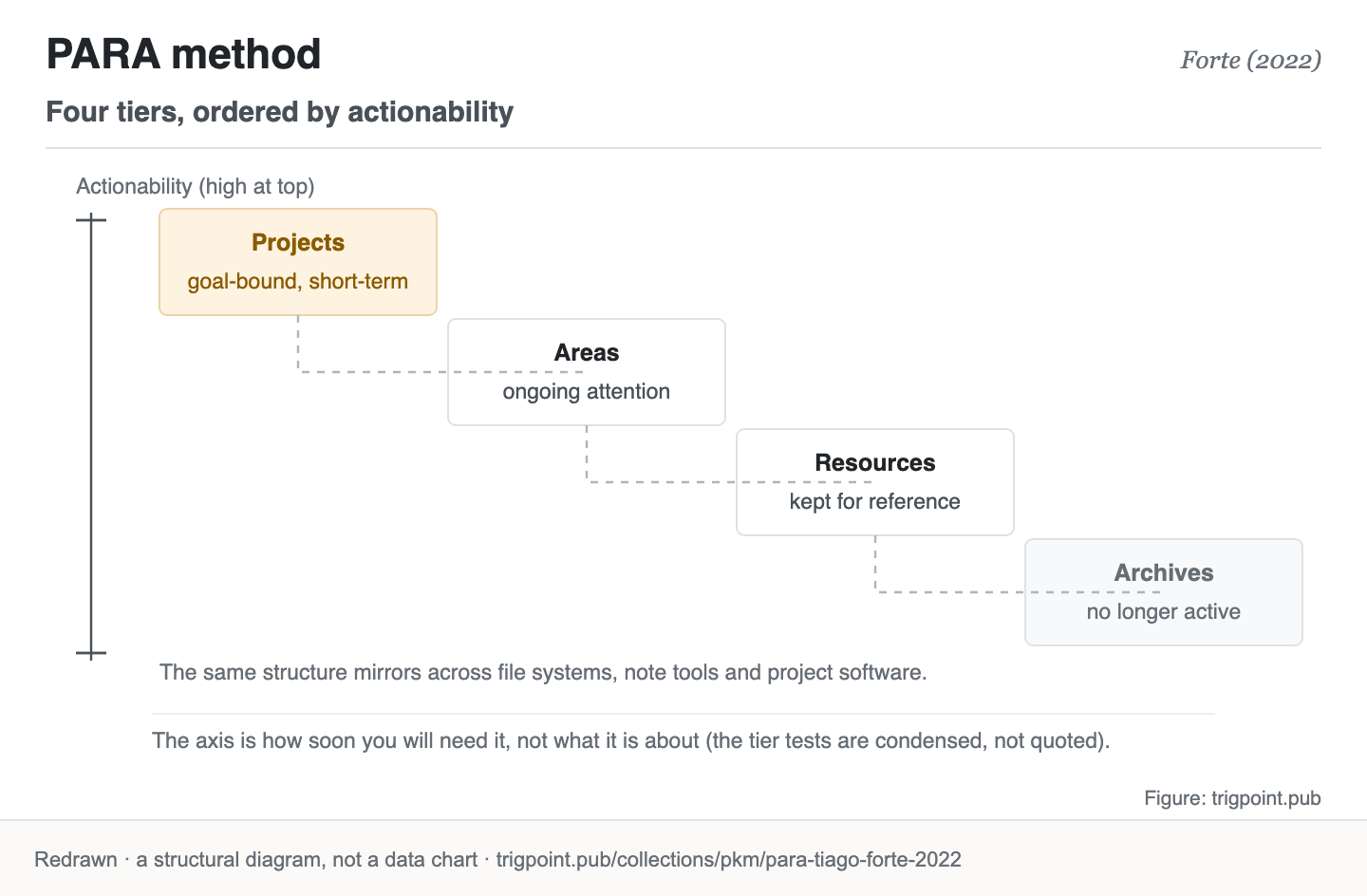
PARA is a four-tier structure for personal organisation ordered by actionability: Projects, Areas, Resources and Archives.It divides the work with networked notes rather than replacing them: PARA says where things are kept, networked notes say how concepts connect.Projects carry a goal, Areas need ongoing attention, Resources are held for reference and Archives are no longer active; a finished project drops into Archives, and the same structure mirrors across every tool.
Figure 1 · Four tiers ordered by actionability, highest first: Projects as short-term efforts with a goal, Areas needing ongoing attention, Resources kept for reference, Archives no longer active. The axis is how soon you will need it, not what it is about. Redrawn; not a reproduction of the book's own diagram. View full size ▸Share PNG ▸
Forte first set out PARA in a 2017 online post and systematised it in Building a Second Brain in 2022[2]Forte Labs. Bibliographic details checked against the official record. The \"organize by actionability\" wording and the four tier names checked against the primary site. Blog, available at fortelabs.com/blog/para. Attribution note: PARA first appeared online in 2017 (month not verified). The current online version is a 2023 republication..
His diagnosis: filing by topic like a librarian produces a cabinet that looks tidy but cannot answer the question you actually have mid-task, which is where the material relevant to the thing in front of me is.
Attribution where due: PARA first appeared online in 2017, and the 2022 book is the milestone for systematisation and reach rather than the year of origin, so a citation to 2022 refers to the book. The expansion is usually given as the plural Archives; the author's spoken interviews and some pages on his own site have used the singular. Organise by actionability is his own phrase, while the commonly appended contrast about context does not appear on his page and reads as a paraphrase against a different productivity system; the contrast on his page is with topic-based filing. Keep the original phrase and the paraphrase apart.
2. Why this matters to you
You test an organisation system not by how tidy it is but by whether it can hand you the relevant material halfway through a task. Filing by topic is most comfortable when collecting and slowest when acting. Filing by actionability is the reverse.
It also comes with an honest decay path. A finished project drops to Archives, and an area nobody is maintaining a standard for has in fact stopped. Topic-based filing lets expired things live respectably where they are. One question about actionability exposes them immediately.
One boundary to keep. PARA governs where things go, not how they link. It does not compete with networked notes; it divides labour with them. One answers where something lives, the other answers how the concepts connect.
Verification layer · Members
The guided layer of this node is open to all readers.
Verification details and failure boundaries are for members.
Reverse engineering: sorting a work overview back into Areas and Projects after work is folded in
Situation: our studio divides its work among several AI roles. On 2026-05-18 one role was retired, and its product work was folded into the work of a receiving role. The receiving role's work was recorded as PARA Areas and Projects in a single work overview; by the audit on 31 May, the work overview had gone two weeks without a review.
Decision point: there were four workable options at the time: update only the status of existing entries; reclassify the whole work overview, re-judging each entry as Area or Project against its actual progress; keep the folded-in work in a separate record, outside the work overview; or split the folded-in work across the existing Areas.
What we did and what happened: we chose to reclassify the whole work overview, and found two kinds of gap. The product work that had been folded in had never been placed in any Area, so a new Area was opened to hold it, rather than splitting it across the existing Areas. Two Projects had already been published but were still listed in the work overview: one was marked as deferred, though it had in fact been published on 21 May; the other had been published on 5 May. Both were closed. The receiving role's day-to-day task list was not restructured at the same time; that step was put off, and its structure was finished only on 14 June.
Take-away: if a work overview has just taken in work from elsewhere, the whole overview can be reclassified once, rather than only having its statuses updated. Minimum viable version: someone who uses only one AI assistant and a to-do list can, this week, have the AI list the date each item was last moved forward and the Area or Project it belongs to; for anything already done, untouched for two weeks, or belonging to no Area or Project, a person then decides whether it stays.
02
Trigpoint PassField record · 2026-08
Classification does not run on self-discipline: how the coverage check became a script
Classification is still a human judgement; whether that judgement reached the record is left to checking programs. One day the start-of-session surface showed “✓ nothing to clear” for four roles, while it could not read the date of a single work line. What should be done with that green tick?
Trigpoint Pass content · includes an applicable list
What the four layers cannot catch: where cross-cutting work goes
A toolkit's content had been finished for three weeks and was still unshipped: its two legs hung on two different work lines, with no single owning surface. PARA assumes every item has one home; where should cross-cutting work go so that someone closes it?
Page verification: Bibliography checked ✓ · Page version v3 · Content last revised 2026-11-22 · Editor review 2026-10-06
References
How to read the source notes “Bibliographic details checked” means author, year, title and venue were confirmed. It does not mean the source's claims were checked. “Checked against the primary site” means the claim was compared with the project's own website. “Follows secondary accounts” means the claim rests on sources that report it, not on the original document. Definitions as of 2026-09-20.
[2] Forte Labs blog. The PARA Method: The Simple System for Organizing Your Digital Life in Seconds. https://fortelabs.com/blog/para/ Bibliographic details checked against the official record. The \"organize by actionability\" wording and the four tier names checked against the primary site. First published in 2017; 2023 republished version.
Tell the editor privately: a correction, a counter-example or where it applies
Submissions are read only by the editor, and your original text and nickname are never published. If a note stands and this node is revised, the revision is listed in this page's correction record; notes that are not adopted currently get no published summary or response. An anonymous note cannot be tracked by its reference number; submit signed in to follow its status on your page. No sign-up is needed, and the nickname may be left blank.
SaveSavedSavedContinue readingReadAllocation ledgersClear saved items and reading history on this deviceThese are kept only in this browser on this device.You can sign in with your email (free) to keep your saved items and ledgers in your account and pick them up on another device.Keep the saved items and ledgers on this device in your account?Keep in my accountNot nowSaved on this device. You can sign in to keep it in your account.Keep saved items and ledgers in my accountIf you turn this off, the saved items and ledgers in your account are deleted. The copy on this device stays.