Members' shelf
All 9 nodes on Naming & Classification are for members only.
Pay with the email you sign in with here, so the Pass is linked to this account.
Members' shelf
All 16 nodes on System Protection & Threat Modeling are for members only.
Pay with the email you sign in with here, so the Pass is linked to this account.
Personal kanban
1. What happened
Kanban comes from the Toyota production line: a signalling mechanism that landed around 1953, using physical cards to control the flow of work in progress, and one of the core components of lean production[2]Toyota Production System: Beyond Large-Scale Production. Productivity Press. Bibliographic details confirmed by two sources. Ohno, T. (1978; English translation 1988). The kanban mechanism landed on the Toyota production line around 1953. The broader Toyota Production System developed from around 1948..
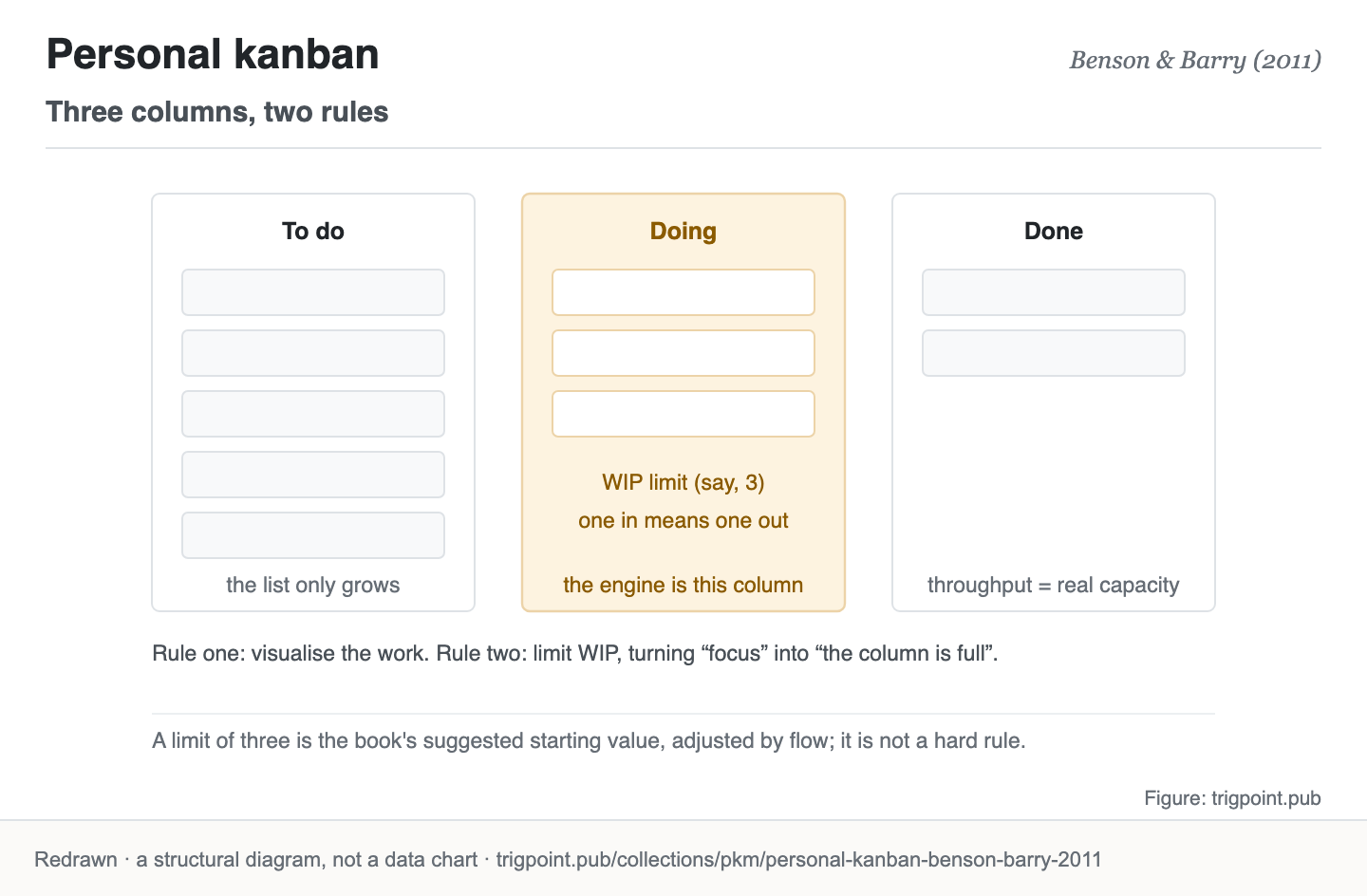
Anderson's 2010 book systematised it as a change method for software development[3]Anderson, D. J. (2010). Kanban: Successful Evolutionary Change for Your Technology Business. Blue Hole Press. Bibliographic details confirmed by two sources. This is the bridge by which kanban was transplanted from manufacturing to software development.. In 2011 Benson and Barry made it personal: one board, three columns of to do, doing and done, and two rules, visualise the work and limit work in progress[1]Benson, J., & Barry, T. D. (2011). Personal Kanban: Mapping Work | Navigating Life. Modus Cooperandi Press. ISBN 9781453802267. Bibliographic details cross-checked against multiple sources. The wording of the two core rules checked against the primary site. A wrong ISBN that does not match this book is in circulation. The suggested starting limit of three is the book's recommended value, not a hard rule.. The book suggests an individual start at a limit of three and adjust to their own throughput. That is a recommendation, not a hard rule.
The insight in the personal version is that overload in knowledge work is usually not too many tasks. It is too many tasks open at once, each one charging a switching tax.
2. Why this matters to you
The difference between a to-do list and a board is the difference between a list and flow control. A list only grows. The doing column has a ceiling, so something has to leave before something new can enter.
That constraint turns a vague question of character, be more focused, into a mechanical question of structure, the column is full.
The largest trap in practice is treating the limit as decoration. Eight cards in the column with a limit of three written above it is the same as having no limit. A limit that bites usually needs a surface that forces you to declare, rather than a daily reminder to yourself.
Visualising the work is not decorative either. A queue you can see gets settled. A queue you cannot see just ferments.
Lab cases 2 first-hand cases from our studio
Start-up alarms list only designated deadlines: an open thread left untouched is no longer an alarm
Situation: at the end of every session we record the work left unfinished as open threads. To keep them from piling up, the start-up view for each role used to list the three left untouched longest and ask for a position on each: continue, defer (a date had to be written), or close; the system never closed a thread on its own. Deferrals written earlier fell due between mid-September and the end of the month.
Decision point: from 1 October the open threads whose deferrals had fallen due came back to the start-up view; up to 6 October, the work logs of one role noted again and again that they had been listed at start-up and drew no response. There were four workable options at the time: (a) keep listing them and wait for a position; (b) defer all of them at once to the same date; (c) show only a count; (d) have the start-up alarms list only deadlines the person running the studio has designated.
What we did and what happened: on 6 October the start-up view listed 8 open threads, and we first took (b), deferring all of them to 20 October; the list emptied, and the due date was only moved back. On 9 October the person running the studio chose (d), deferral markers stopped being written, and open threads left untouched moved to a review someone starts on purpose. The first reading after the change listed three designated dates across the studio, one of them already 8 days overdue.
Take-away: a queue that can be seen gets settled, but open threads that are listed can also just be pushed back. If a reminder can only be switched off by writing a deferral date, that date tends to be written just to switch the reminder off, and the reminder goes off again when the date falls due; in that case the start-up alarms can list only the deadlines the person running the studio has designated, with untouched open threads left to a review someone starts on purpose. Someone who uses only one AI assistant and a to-do list can, this week, ask the AI to list each day only the items whose deadline has passed.
The weekly review of work in progress: three questions beyond the number
Once a week we read how many items are in progress at once, with a limit of 3. Then we found two places that both said “limit 3” with denominators sevenfold apart. How should the number be counted and read? The three readings below were left behind only after reading it wrong.
Trigpoint Pass content · includes an applicable list
Full access to the lab cases. Trigpoint Pass ▸
How to read the source notes “Bibliographic details checked” means author, year, title and venue were confirmed. It does not mean the source's claims were checked. “Checked against the primary site” means the claim was compared with the project's own website. Definitions as of 2026-09-20.
- [1] Benson, J., & Barry, T. D. (2011). Personal Kanban: Mapping Work | Navigating Life. Seattle: Modus Cooperandi Press. https://moduscooperandi.com/modus-cooperandi/blog/personal-kanban-the-book ↩
- [2] Ohno, T. (1988). Toyota Production System: Beyond Large-Scale Production. Cambridge, MA: Productivity Press. 2019 digital reprint: https://doi.org/10.4324/9780429273018
- [3] Anderson, D. J. (2010). Kanban: Successful Evolutionary Change for Your Technology Business. Blue Hole Press. ↩
Tell me when a new shelf opens
Tell me when a new shelf opens
Shelf notices are sent only when a new shelf opens or when the reading rules change.
Tell the editor privately: a correction, a counter-example or where it applies
Submissions are read only by the editor, and your original text and nickname are never published. If a note stands and this node is revised, the revision is listed in this page's correction record; notes that are not adopted currently get no published summary or response. An anonymous note cannot be tracked by its reference number; submit signed in to follow its status on your page. No sign-up is needed, and the nickname may be left blank.
We have your note