Members' shelf
All 9 nodes on Naming & Classification are for members only.
Pay with the email you sign in with here, so the Pass is linked to this account.
Members' shelf
All 16 nodes on System Protection & Threat Modeling are for members only.
Pay with the email you sign in with here, so the Pass is linked to this account.
CODE method
1. What happened
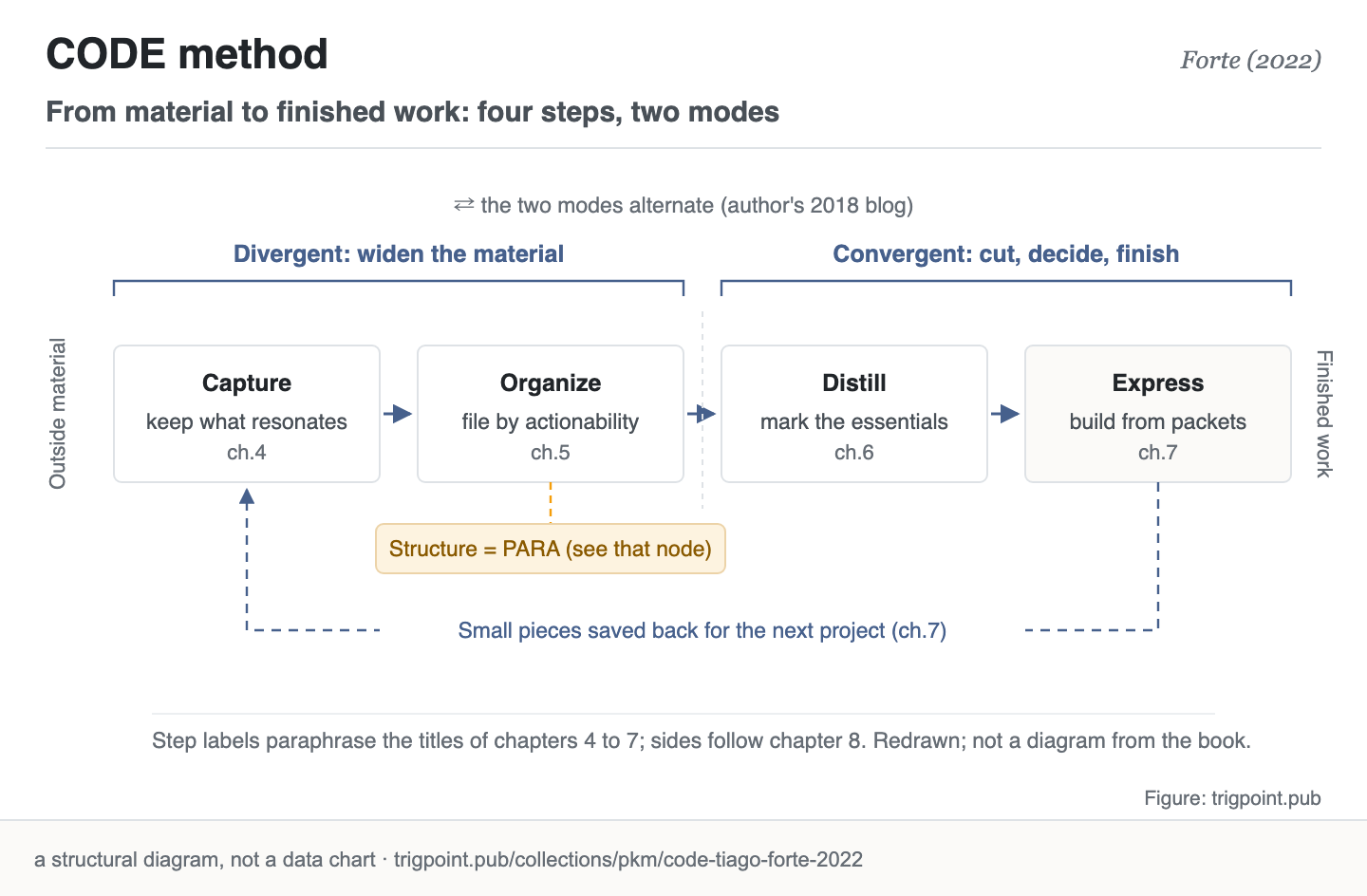
Treating the four steps as a single pass that ends in delivery misses two structures in the book. Tiago Forte's Building a Second Brain, published in 2022, sets out its method as four steps, one per chapter across chapters 4 to 7[1]Forte, T. (2022). Building a Second Brain. Atria Books / Simon & Schuster. ISBN 9781982167387. Bibliographic details cross-checked against multiple sources. The two-sided mapping in the chapter 8 passage on divergence and convergence (approx. p.178–180) follows secondary accounts that agree with one another..
Capture keeps only material that strikes you. Organize files it by actionability rather than by topic, using the book's own PARA structure. Distill applies progressive summarisation, marking what matters in layers so it can be picked up at a glance later. Express produces work in intermediate packets: a finished piece is assembled from existing small pieces, which are saved back and can be reused in the next project[1]Forte, T. (2022). Building a Second Brain. Atria Books / Simon & Schuster. ISBN 9781982167387. Bibliographic details cross-checked against multiple sources. The two-sided mapping in the chapter 8 passage on divergence and convergence (approx. p.178–180) follows secondary accounts that agree with one another..
Chapter 8, The Art of Creative Execution, then splits the four steps into two working modes. Capture and Organize are divergent and widen the material available. Distill and Express are convergent: they cut, decide and produce the finished piece[1]Forte, T. (2022). Building a Second Brain. Atria Books / Simon & Schuster. ISBN 9781982167387. Bibliographic details cross-checked against multiple sources. The two-sided mapping in the chapter 8 passage on divergence and convergence (approx. p.178–180) follows secondary accounts that agree with one another.. In a 2018 blog post the author describes the two modes as alternating, and says the model comes from Design Thinking[2]Forte Labs. Bibliographic details checked against the official record. The two blog statements and the timing of the acronym checked against the primary site. The author's blog (fortelabs.com) and @fortelabs posts. The statements that the two modes alternate and that the model comes from Design Thinking are both from the blog, not from the book..
2. Why this matters to you
A note system usually stalls after collecting. Material keeps piling up and finished work does not appear. CODE separates storing from delivering into four steps with distinct jobs, and each can be checked on its own: has this material been distilled yet? Have the distilled points gone into a piece of finished work?
The chapter 8 split adds one more test. While you are still widening the range of options, you are diverging. Once you start cutting and deciding, you are converging.
One boundary to keep. CODE covers how material becomes finished work. Where things are kept in the Organize step is answered by PARA, which this page does not restate; see the PARA node.
Open question · AI-drafted Trial
A note system usually stalls after collecting. Material keeps piling up and finished work does not appear.
Where does your note system get stuck? The last time you got from collected material to finished work, what did you do in between that made it work?
Tell the editor privately ▸Why is this here?
This node has no reader responses yet, so we put one question here as a starting point. It is not the editor's view of the node. It is folded away once readers respond, or at the first monthly update after it has been up for 30 days.
Lab cases One first-hand case from our studio
One figure, two outlets: the node's own figure goes straight into the video
Situation: in late September 2026, as we were building this page, a Triglens video on the same book, not yet published, already had a section on CODE. The video is made by an external agent. On 29 September the external agent, at the request of the person running the studio, proposed two figures made for the site, with the site's original files shared by both outlets, and asked which side should make them.
Decision point: there were at least four workable options. One, each side draws its own version. Two, the video draws first and the site reuses it. Three, once the node text is final, draw the figure from that text and have the video take the node's original. Four, share one figure, but draw it first and write the text afterwards.
What we did and what happened: on 29 September the person running the studio ruled for the third option, with only one of the two figures going on the site. The figure is itself an intermediate packet: a small piece that can be saved back and reused in the next project. On 30 September we finished the text and both language versions of the figure, and then passed them to the external agent. On 1 October the external agent checked the two files, and the hash of each matched the value we had sent with it. Both versions then went into the video whole and to scale, without redrawing or any change of wording. The video was published on 4 October; on 21 October we checked the published version by eye, and the figure was the same as on this page. What we have not yet seen is a revision: a published video stays fixed, so if the figure on this page changes later, the video will not follow.
Take-away: if the same material is to be used in two finished pieces, and one of them, such as a video, stays fixed once published, it can be finalised in one place and taken as the original file in the other, with a check before use that the two files match. Someone who uses only one AI assistant and a set of notes can, this week, pick one passage needed in two places, keep a single final copy in the notes, paste it into the other place, and then compare the two once to see that the wording is the same.
Full access to the lab cases. Trigpoint Pass ▸
How to read the source notes “Bibliographic details checked” means author, year, title and venue were confirmed. It does not mean the source's claims were checked. “Checked against the primary site” means the claim was compared with the project's own website. “Follows secondary accounts” means the claim rests on sources that report it, not on the original document. Definitions as of 2026-09-20.
- [1] Forte, T. (2022). Building a Second Brain: A Proven Method to Organize Your Digital Life and Unlock Your Creative Potential. New York: Atria Books / Simon & Schuster. https://www.simonandschuster.com/books/Building-a-Second-Brain/Tiago-Forte/9781982167387 Bibliographic details cross-checked against multiple sources. The two-sided mapping in the chapter 8 passage on divergence and convergence (approx. p.178–180) follows secondary accounts that agree with one another. ↩
- [2] Forte Labs blog. Divergence and Convergence: The Two Fundamental Stages of the Creative Process (2022-05-16); Just-In-Time PM #8: Divergence and Convergence (2018-05-23). https://fortelabs.com/blog/ Bibliographic details checked against the official record. The two blog statements and the timing of the acronym checked against the primary site.
Tell me when a new shelf opens
Tell me when a new shelf opens
Shelf notices are sent only when a new shelf opens or when the reading rules change.
Tell the editor privately: a correction, a counter-example or where it applies
Submissions are read only by the editor, and your original text and nickname are never published. If a note stands and this node is revised, the revision is listed in this page's correction record; notes that are not adopted currently get no published summary or response. An anonymous note cannot be tracked by its reference number; submit signed in to follow its status on your page. No sign-up is needed, and the nickname may be left blank.
We have your note