Members' shelf
All 9 nodes on Naming & Classification are for members only.
Pay with the email you sign in with here, so the Pass is linked to this account.
Members' shelf
All 16 nodes on System Protection & Threat Modeling are for members only.
Pay with the email you sign in with here, so the Pass is linked to this account.
Evergreen notes
1. What happened
Matuschak, previously an iOS engineer at Apple and a researcher at Khan Academy, has practised and set out these disciplines on a public working-notes site that he keeps updating; its pages carry no date of writing[1]Matuschak, A. Working Notes. The three disciplines checked against the primary site. Available at notes.andymatuschak.org, continuously updated; the pages carry no date of writing. This is an individual practitioner's working notes. There is no book and no paper. They are atomic, concept-oriented and densely linked, and appear as verbatim headings on the site. Attribution note: a fourth principle, “context-free”, circulates widely but was checked and does not exist on the original site. It is a common misreport..
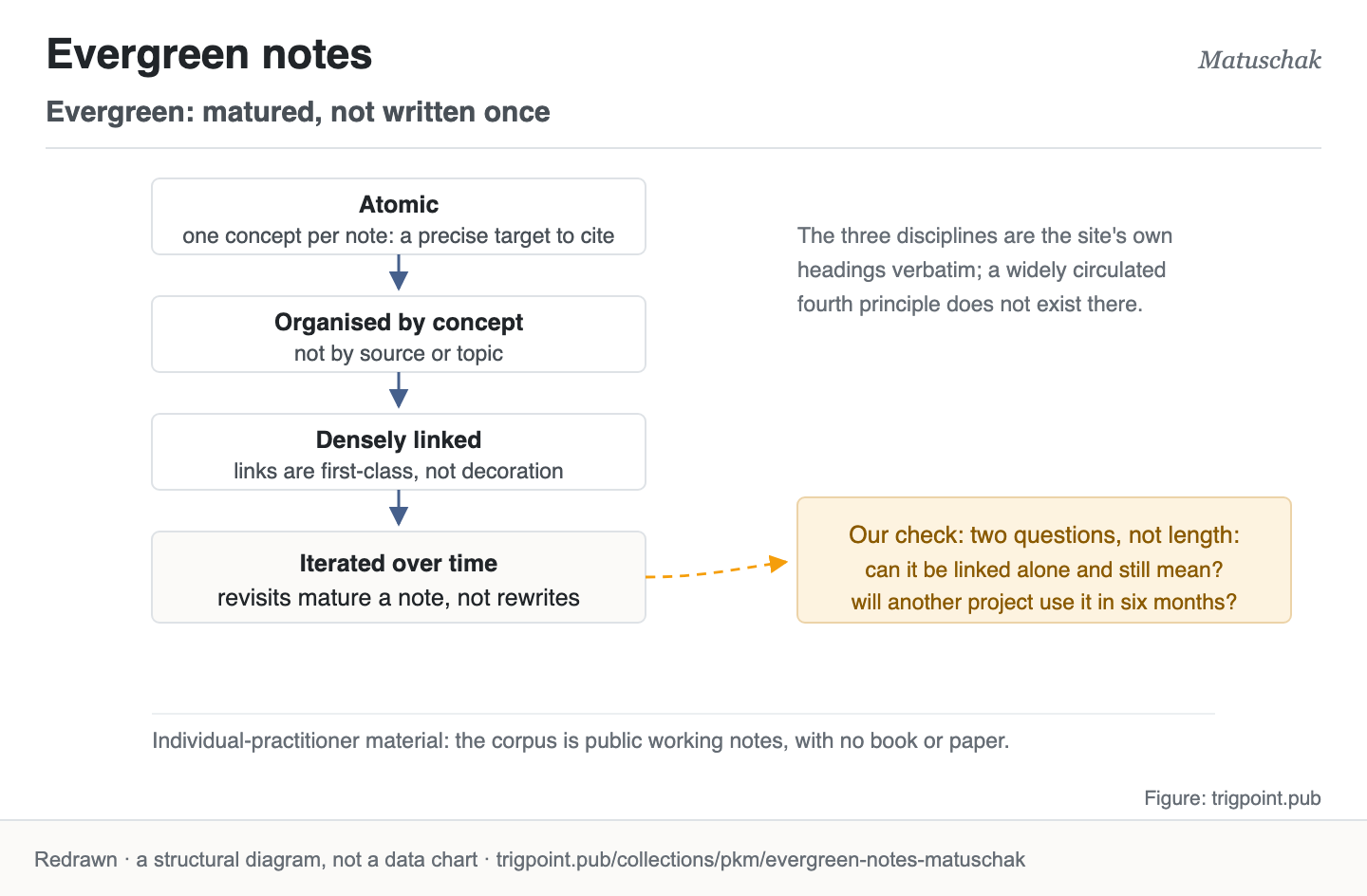
The three principles are verbatim headings on that site. A note should be atomic, one concept per node, so that a reference has a precise target, while still covering that concept as fully as possible. It should be organised by concept, since a single topic can split into several concept nodes and the concept is the unit of reuse. And it should be densely linked, with links treated as first-class rather than decorative.
He states that the concept is deeply indebted to the slip-box tradition. This is a restatement and refinement of networked note-taking for the era of digital tools, not a new invention. A fourth principle in wide circulation, that notes should be context-free, does not exist on the site; it is derivative spirit mistaken for a standalone rule; the site carries two further principle headings, neither of them context-free.
2. Why this matters to you
The intuition that more detail is better treats a note like an essay. An essay's unit is the argument; a note system's unit is the concept. Take how we work here as an example. If the useful part of an eight-hundred-word reflection is one criterion inside it, that criterion is hard to cite on its own; give it a note of its own and a link has a precise target.
We check with two questions. Can this note be linked on its own without losing its meaning? And in six months, on a different project, will it still be usable? This is our working method, not a general rule from the original site.
It also matters when to stop. The site's note "Evergreen notes should be atomic" says that fragmenting notes too far fragments the link network with them, and that where to draw the line is a matter of trade-offs with no clear test[1]Matuschak, A. Working Notes. The three disciplines checked against the primary site. Available at notes.andymatuschak.org, continuously updated; the pages carry no date of writing. This is an individual practitioner's working notes. There is no book and no paper. They are atomic, concept-oriented and densely linked, and appear as verbatim headings on the site. Attribution note: a fourth principle, “context-free”, circulates widely but was checked and does not exist on the original site. It is a common misreport.. If a concept split into pieces leaves each piece unable to say it completely, it should not be split further.
There is one position that inverts easily. Evergreen means matured, not written well the first time. Notes get there through revisits. Aiming for a perfect note at the outset tends to stop people going back to change it.
Lab cases 2 first-hand cases from our studio
Promotion to evergreen: a class with weaker sources gets a stricter condition
Situation: our knowledge library records how mature a node is in a separate state field, and the highest level is evergreen; the promotion conditions for each level are our own. The top level borrows its name from evergreen notes, but in our library what earns it is source checking, not the shape of the note. The general rule at the time was that a node counted as evergreen once it had been through one round of in-depth source checking. Practices that founders describe about themselves form a class with a rule of its own: one round counts only as distilled, and evergreen takes two or more independent checks plus a citation from another line of work.
Decision point: on 2026-05-30, twelve nodes finished a round of checking; six of them rest on founders' own accounts, and the two rules gave different answers for those six. There were four workable options at the time. One, promote all twelve under the general rule. Two, take the six only as far as distilled under the class rule and promote the rest to evergreen. Three, first change the class rule to match the general rule, then promote all twelve. Four, hold all twelve until the two rules are reconciled.
What we did and what happened: we took the second option, and the person running the studio approved it, on the basis that where a class has its own rule, that rule applies over the general one. The six methods and frameworks were promoted to evergreen, and the six cases stopped at distilled. Negative result: as of 2026-11 the six have still not reached evergreen; at the time it was already expected that a second independent source would be hard to find for a founder's own account.
Take-away: if one class of content rests on weaker sources, such as people describing their own practice, a stricter promotion condition can be set for that class, with the class rule applying where it conflicts with the general one; the cost is that the class may stay a level down for a long time. Minimum viable version: someone who uses only one AI assistant and a set of notes can add a checked field this week. An ordinary entry is marked once they have personally found a source for it; entries whose only source is someone's own account are listed apart by the AI and marked only once a second independent source turns up.
When a discipline counts as mature: the promotion gate from incubation to the main library
Promotion into the main library takes four gates. Communication studies had reached its ninth node, one short of the first gate, when a candidate came up that would make the tenth, a concept whose academic standing is contested. Taking it would clear the gate; the question was whether it belonged.
Trigpoint Pass content · includes applicable criteria
Full access to the lab cases. Trigpoint Pass ▸
How to read the source notes “Checked against the primary site” means the claim was compared with the project's own website. Definitions as of 2026-09-20.
- [1] Matuschak, A. Working Notes. https://notes.andymatuschak.org/Evergreen_notes The three disciplines checked against the primary site. Continuously updated, with no date of writing; individual practitioner working notes. ↩
Tell me when a new shelf opens
Tell me when a new shelf opens
Shelf notices are sent only when a new shelf opens or when the reading rules change.
Tell the editor privately: a correction, a counter-example or where it applies
Submissions are read only by the editor, and your original text and nickname are never published. If a note stands and this node is revised, the revision is listed in this page's correction record; notes that are not adopted currently get no published summary or response. An anonymous note cannot be tracked by its reference number; submit signed in to follow its status on your page. No sign-up is needed, and the nickname may be left blank.
We have your note